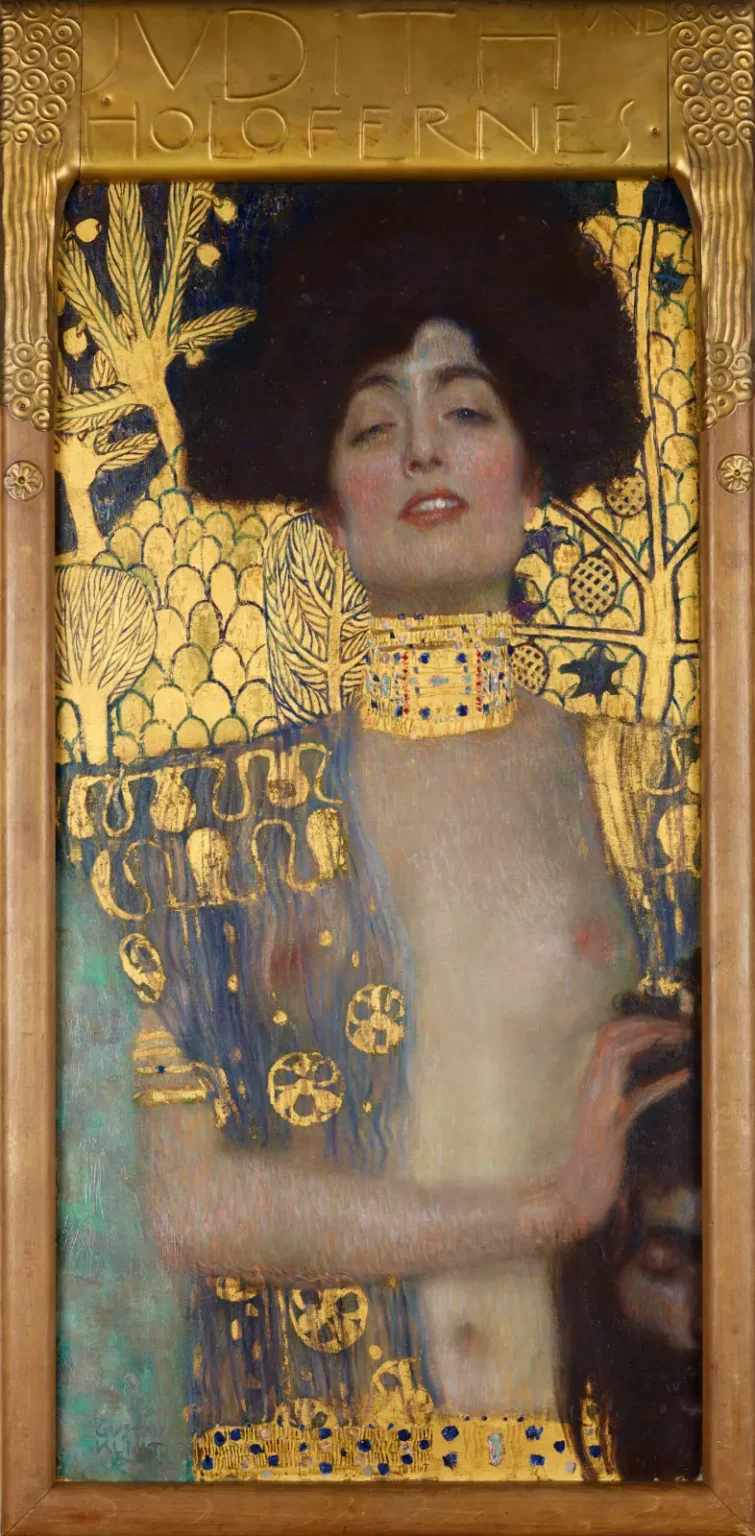
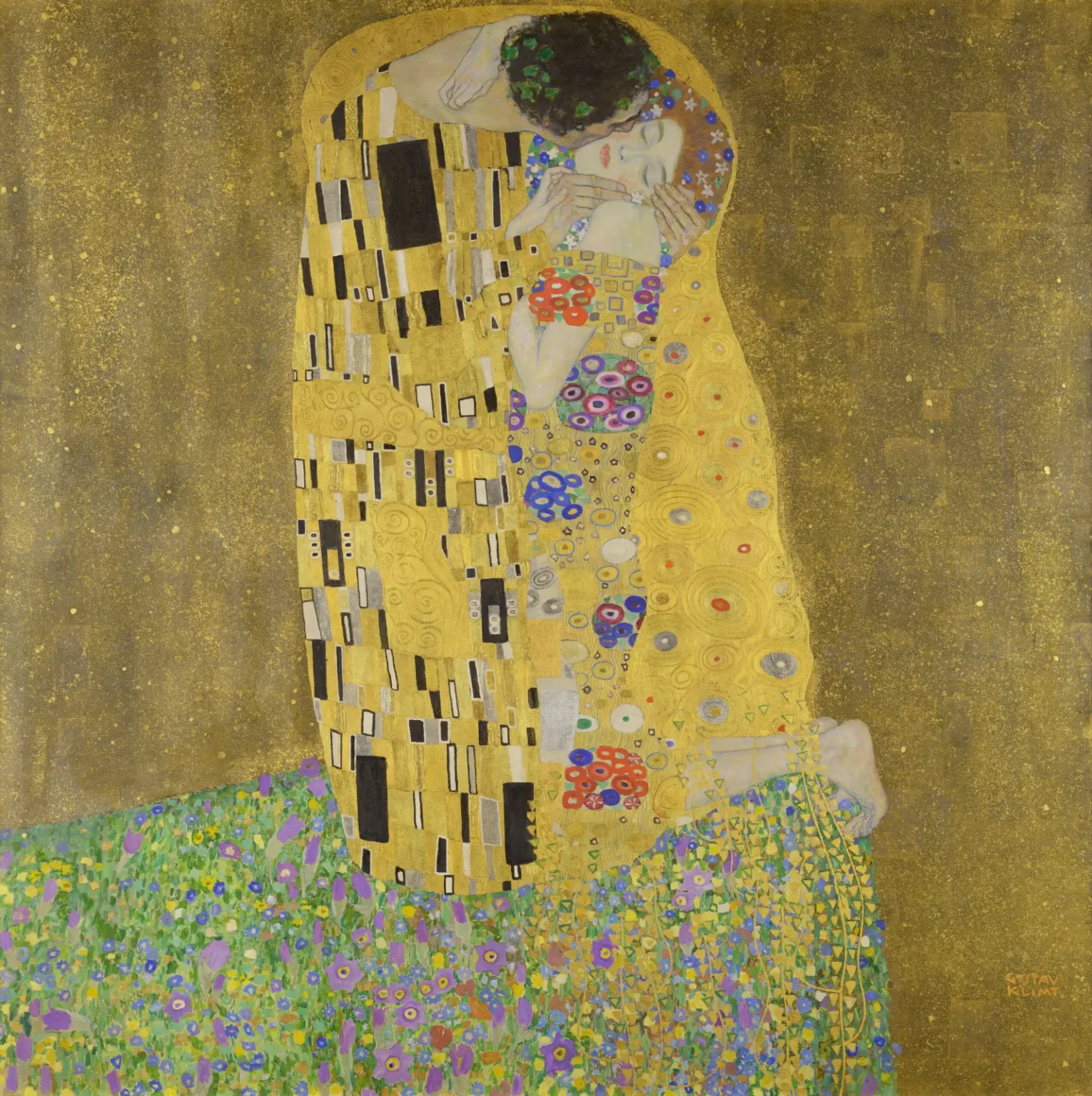
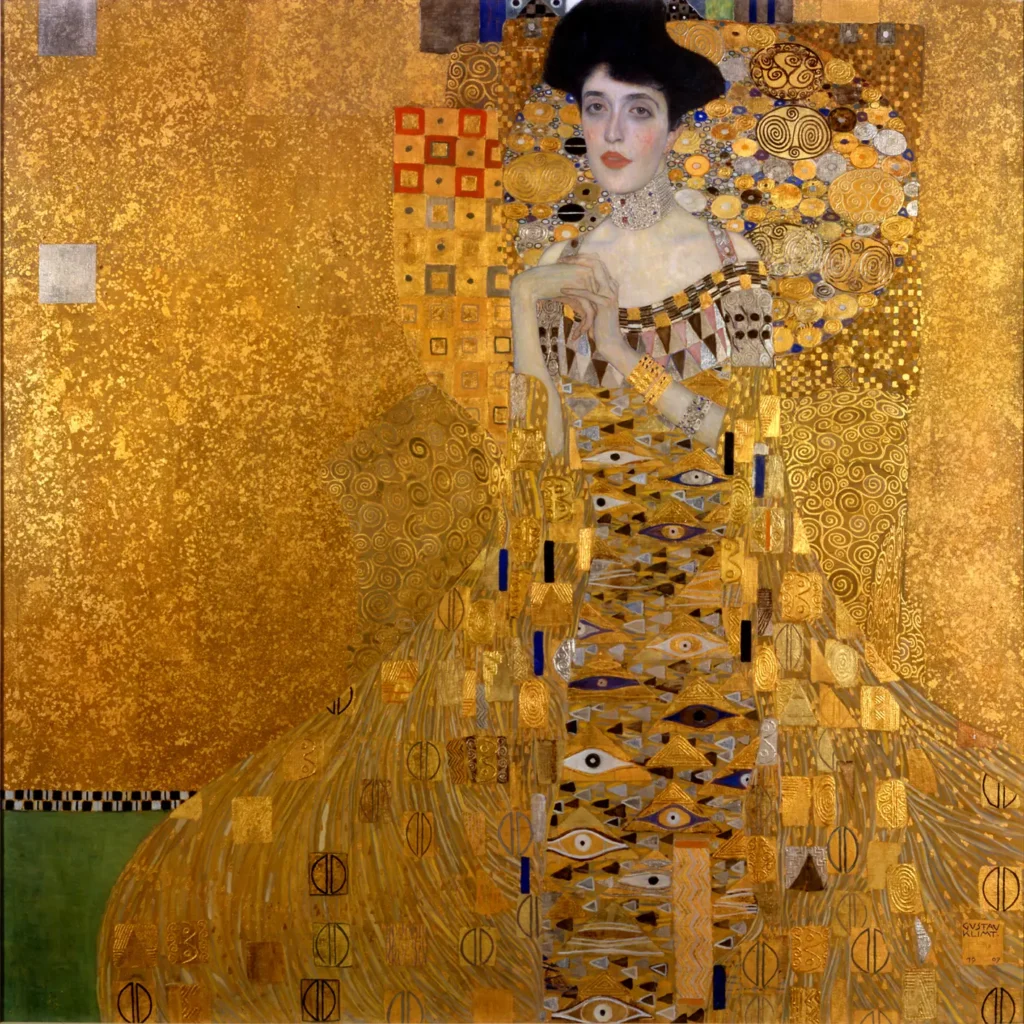
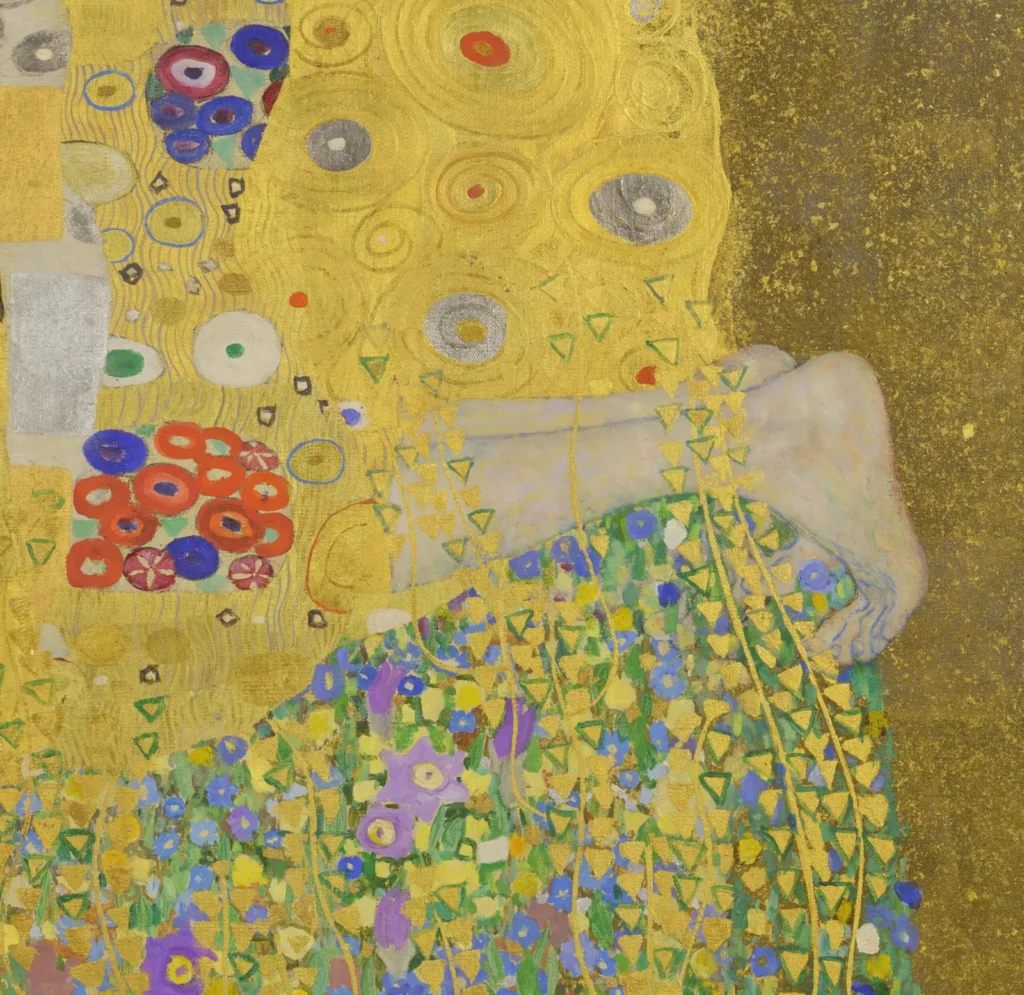
Klimt’s Golden Phase (or Golden Period) is the name given to the years from around 1899 to 1910, when he set naturalistically painted faces and bodies against flat, richly patterned grounds of gold and silver leaf. It produced The Kiss, the Portrait of Adele Bloch-Bauer I and many of his most famous works.
InfluencesWhere the gold came from
Gold was in Klimt’s background long before it was in his paintings. His father was a gold engraver, and Klimt himself had trained at the Vienna School of Arts and Crafts, where students learned decorative techniques as well as painting. The Secession’s belief that fine and applied art were equal encouraged him to bring the materials of the craftsman onto the canvas.
The decisive influence was Byzantine art. In 1903 Klimt travelled to Ravenna, where the sixth-century mosaics of San Vitale, with their flat golden grounds and jewelled, frontal figures of the Emperor Justinian and Empress Theodora, made a deep impression on him. Japanese prints and lacquerwork, Egyptian and Mycenaean ornament and the patterned textiles of the Wiener Werkstätte all fed into the style.
How he did itThe technique
Klimt applied real gold and silver leaf, beaten to sheets far thinner than paper, over prepared areas of the canvas, combining it with oil paint, gold paint and, in places, raised gesso that catches the light. In The Kiss and Adele Bloch-Bauer I the leaf is worked into dense patterns of spirals, eyes, rectangles and circles, so that the clothing and background dissolve into ornament while the faces and hands remain soft, painted flesh.
The contrast is the point. The bodies are three-dimensional and real; everything around them is flat, precious and abstract, as if the figures were icons or relics.
1898–1909The key works
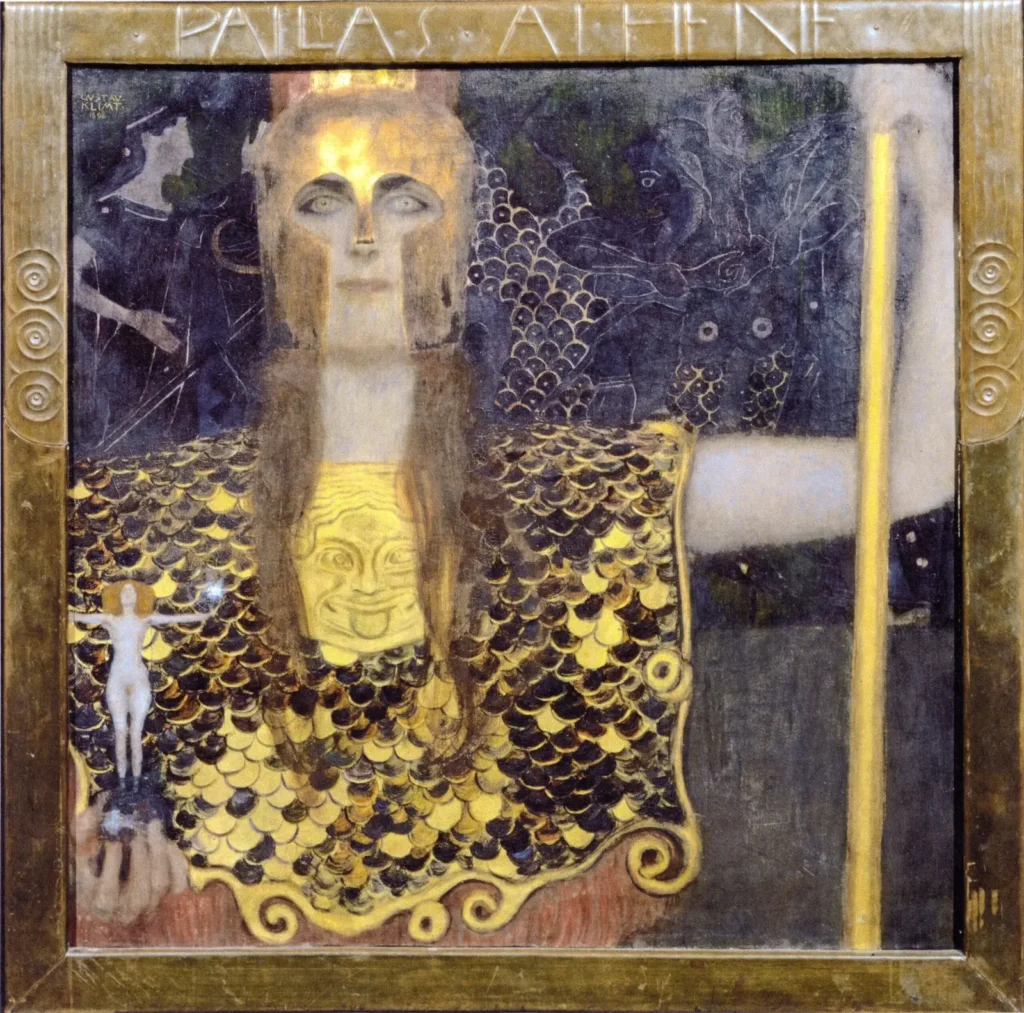
Pallas Athene (1898) and Judith I (1901) were the first major paintings to use gold. Over the next decade came the Beethoven Frieze (1902), Hope II (1907–08), Danaë (1907–08), the Portrait of Adele Bloch-Bauer I (1907), The Kiss (1907–08) and the designs for the Stoclet Frieze in Brussels, executed in mosaic by the Wiener Werkstätte.
After 1909The end of the gold
Judith II (1909) is usually seen as the last great painting of the Golden Phase. Around 1909–10 Klimt turned away from gold towards bright colour and dense, flattened pattern, a change often linked to his encounter with the work of the French post-impressionists and Fauves and to his growing collection of Chinese and Japanese art. The late portraits such as Mäda Primavesi and Lady with a Fan are as decorative as ever, but painted entirely in colour.
Explore every period of his work in our Klimt painting catalogue.
 The Kiss
 Adele Bloch-Bauer I
 The Vienna Secession
 The Life of Gustav Klimt