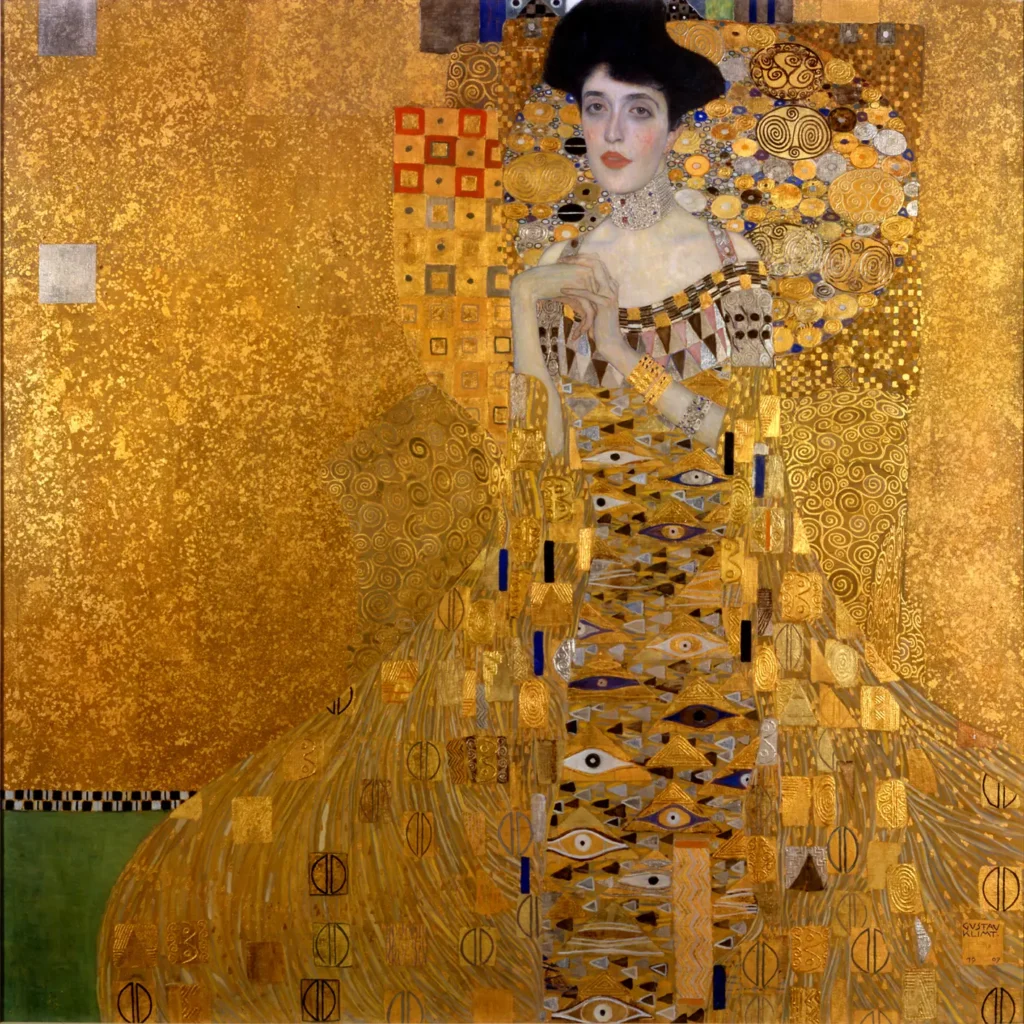
The Portrait of Adele Bloch-Bauer I, known as the “Woman in Gold”, is the subject of one of the most famous art restitution cases of all time. Its story runs from the salons of Vienna 1900 through Nazi looting to the US Supreme Court.
Vienna 1900Adele and Ferdinand
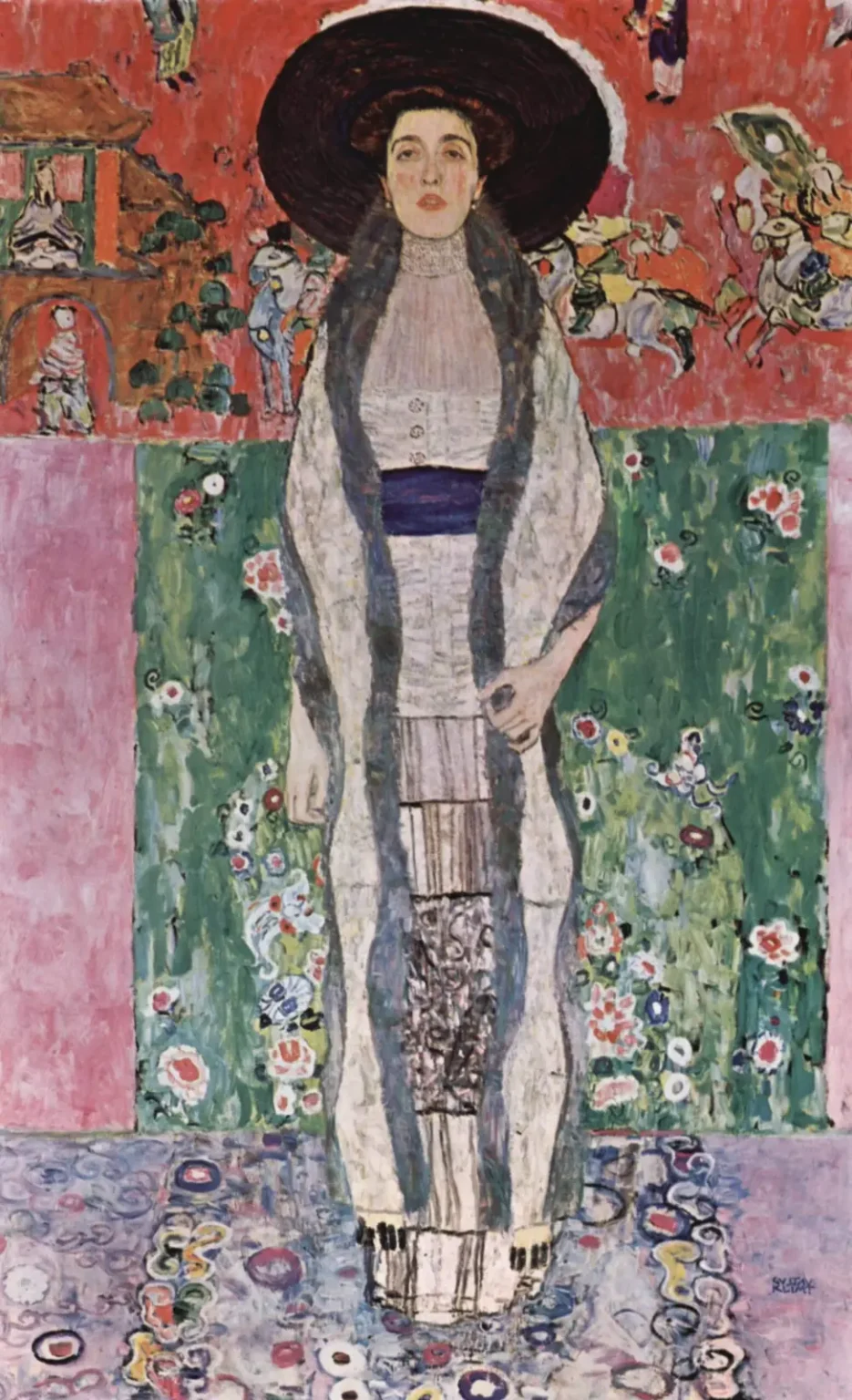
Adele Bloch-Bauer (1881–1925) was the wife of the sugar industrialist Ferdinand Bloch-Bauer and the hostess of one of Vienna’s leading salons. Ferdinand commissioned Klimt to paint her, and the gold portrait was completed in 1907. Klimt painted her again in 1912, making Adele the only person he painted in two full-length portraits. The couple also owned four of his landscapes.
Adele died of meningitis in 1925. In her will she asked her husband to leave the Klimt paintings to the Austrian state gallery after his death, a request that would become central to the legal battle decades later.
1938Looted
When Nazi Germany annexed Austria in March 1938, Ferdinand Bloch-Bauer, who was Jewish, fled to Czechoslovakia and later to Switzerland. His property in Vienna, including the Klimts, was seized. The gold portrait went to the Austrian state gallery, where it was displayed under the title “Lady in Gold” to hide the identity of its Jewish sitter. Ferdinand died in Zurich in 1945, having left his estate to his nephews and nieces, among them Maria Altmann.
The heirMaria Altmann
Maria Altmann, Adele’s niece, escaped Austria with her husband after the annexation and settled in Los Angeles. For decades after the war, Austria treated the Klimt paintings as the property of the state, relying on Adele’s will. In the late 1990s new Austrian legislation on looted art and research by the journalist Hubertus Czernin brought documents to light suggesting the paintings had never legally passed to the state.
1999–2006Altmann v. Austria
Austria refused to return the paintings, and the cost of suing in Austrian courts was prohibitive. With her lawyer E. Randol Schoenberg, grandson of the composer Arnold Schoenberg, Altmann sued the Republic of Austria in the United States. In 2004 the US Supreme Court ruled in Republic of Austria v. Altmann that her case could proceed. The two sides then agreed to binding arbitration in Austria, and in January 2006 the arbitration panel ruled that five Klimt paintings must be returned to the heirs.
2006The five paintings
The paintings returned were the Portrait of Adele Bloch-Bauer I, the Portrait of Adele Bloch-Bauer II, Apple Tree I, Birch Forest and Houses in Unterach on the Attersee. Their departure from Vienna was felt as a national loss in Austria. In June 2006 the gold portrait was bought by Ronald Lauder for a reported $135 million for his Neue Galerie in New York, where it remains on view. The other four were sold at Christie’s in November 2006.
2015The film
Maria Altmann died in 2011, aged 94. Her story was told in the 2015 film Woman in Gold, with Helen Mirren as Altmann and Ryan Reynolds as Schoenberg. Today the portrait is one of the most visited works in New York; see it with our guide to where to see Klimt, or read about the most expensive Klimt paintings.
 Adele Bloch-Bauer I
 Most expensive Klimts
 The Golden Phase
 Lost Klimt paintings