The Vienna Secession (Wiener Secession) was an association of artists founded in Vienna in 1897, with Gustav Klimt as its first president. It broke with the conservative art establishment and became the centre of modern art and design in fin-de-siècle Vienna.
1897The break with the Künstlerhaus
In the 1890s exhibitions in Vienna were dominated by the Künstlerhaus, the city’s established artists’ association, which favoured historical and academic painting and showed little foreign modern art. In April 1897 a group of younger members led by Klimt formed a new association within it. Within weeks the conflict became a complete break, and the group left to go its own way.
The founders included the painters Koloman Moser, Carl Moll and Max Kurzweil and the architects Josef Hoffmann and Joseph Maria Olbrich. The elderly watercolourist Rudolf von Alt agreed to be honorary president, and the architect Otto Wagner joined in 1899.
The building“To every age its art”
The Secession’s first exhibition opened in 1898 in a rented hall. That same year the group opened its own exhibition building on the edge of the Naschmarkt, designed by Olbrich: a white, almost windowless block crowned by a dome of gilded laurel leaves that the Viennese nicknamed the “golden cabbage”. Above the entrance is the motto written for the Secession by the critic Ludwig Hevesi: Der Zeit ihre Kunst, der Kunst ihre Freiheit, “To every age its art, to art its freedom”.
Inside, the building was designed as a flexible series of top-lit spaces that could be rearranged for every exhibition, an idea that influenced gallery design for a century.
1898–1905Ver Sacrum and the exhibitions
The Secession published its own magazine, Ver Sacrum (“Sacred Spring”), from 1898 to 1903, a showcase for its members’ graphic design and illustration. Its exhibitions brought the work of artists from across Europe to Vienna, and each was treated as a designed whole, with members planning the rooms, posters and catalogues.
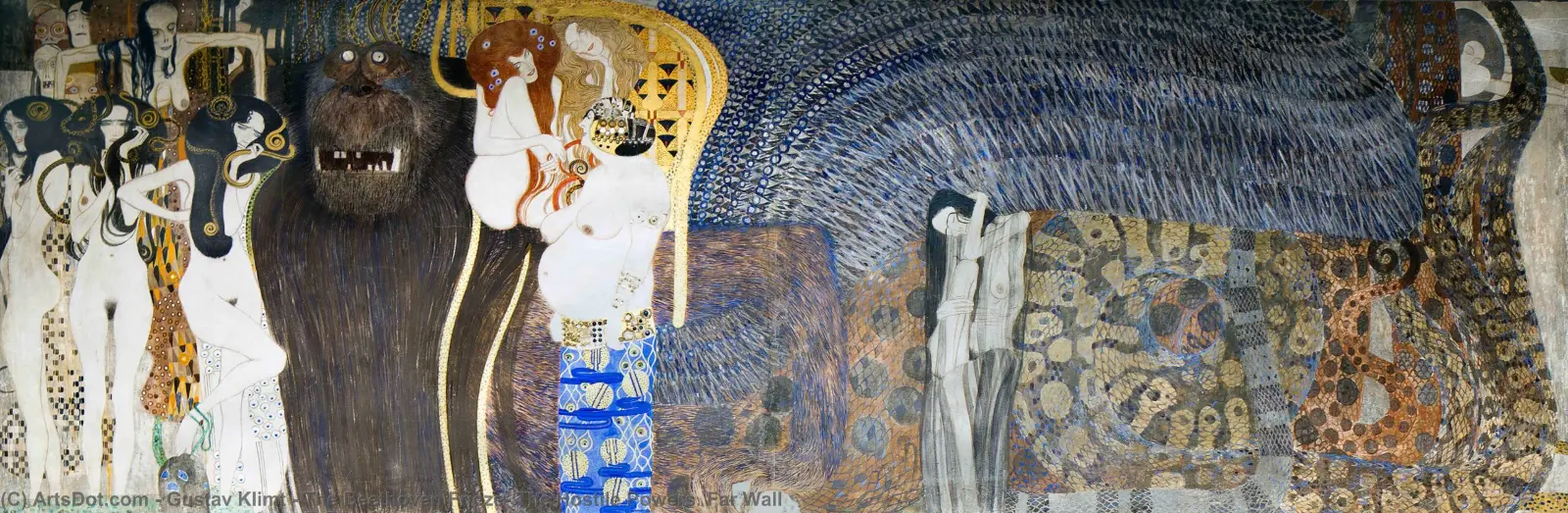
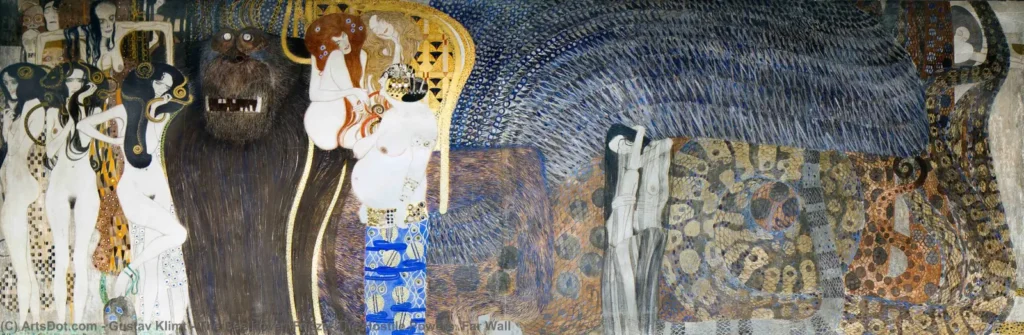
The most famous was the 14th exhibition in 1902, dedicated to Beethoven and built around Max Klinger’s statue of the composer. Klimt painted the Beethoven Frieze for it, a work that was intended to be temporary but survives and is shown again in the building today.
The Secession also introduced Viennese audiences to modern French and Dutch painting, including works by Vincent van Gogh, shown at its 1903 exhibition on the development of Impressionism.
Manifestos in paintKlimt’s Secession paintings
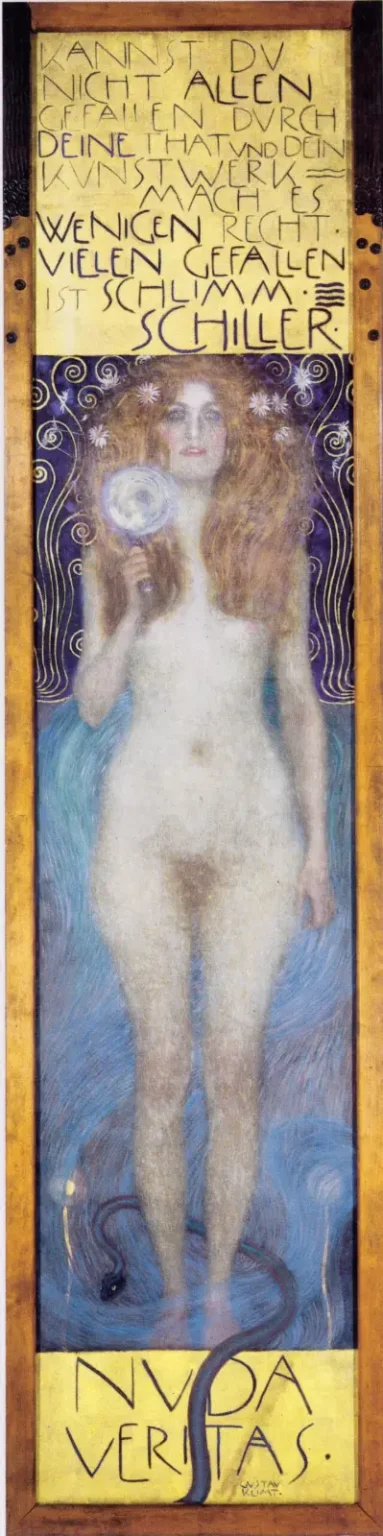
Klimt designed the poster for the first Secession exhibition, showing Theseus slaying the Minotaur, a clear image of the young artists against the old order. His painting Pallas Athene (1898), with the goddess of wisdom as the Secession’s armoured patron, and Nuda Veritas (1899), a naked figure holding up a mirror to the viewer, made the movement’s ideals explicit. The faculty paintings for the University of Vienna, shown at the Secession from 1900, made Klimt the most controversial artist in Austria.
1903The Wiener Werkstätte
The Secession believed that art should shape every part of life, from buildings and furniture to clothes and cutlery. In 1903 Hoffmann and Moser, with the financier Fritz Waerndorfer, founded the Wiener Werkstätte, a workshop for the applied arts. Klimt worked closely with it, most famously on the Stoclet Frieze for the Palais Stoclet in Brussels.
The Klimt groupThe split of 1905
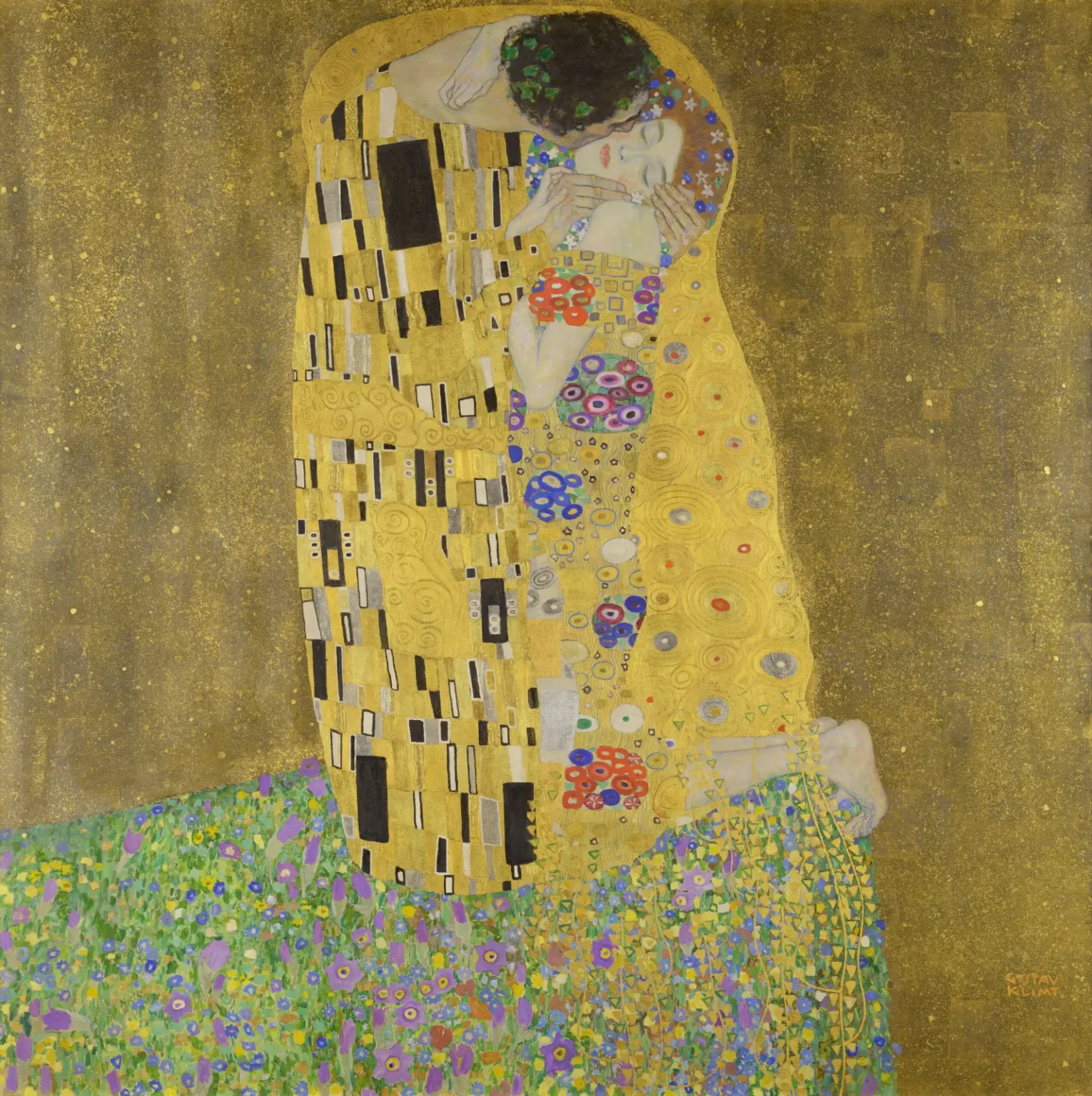
By 1905 the Secession was divided between painters who wanted to concentrate on easel painting and the circle around Klimt, which favoured the total work of art uniting painting, architecture and design. Klimt, Hoffmann, Moser, Wagner, Moll and others left. As the “Klimt group” they went on to stage the Kunstschau of 1908 and 1909, where The Kiss was first shown and young artists such as Oskar Kokoschka and Egon Schiele found an audience.
The Secession itself continued without them and still exists today, showing contemporary art in Olbrich’s building. See it, and the Beethoven Frieze, with our guide to where to see Klimt in Vienna.
 The Life of Gustav Klimt
 The Golden Phase
 The Beethoven Frieze
 All Klimt paintings