The Life of Gustav Klimt
Born the son of a struggling gold engraver, Klimt became the most celebrated and most controversial painter in Vienna. This is his story, from Baumgarten to the Golden Phase.
Gustav Klimt (14 July 1862 – 6 February 1918) was an Austrian symbolist painter, co-founder and first president of the Vienna Secession, and the creator of some of the most recognisable images in Western art, among them The Kiss and the Portrait of Adele Bloch-Bauer I.
1862–1876Childhood in Baumgarten
Klimt was born on 14 July 1862 in Baumgarten, then a village on the western edge of Vienna and now part of the city’s 14th district. He was the second of seven children of Ernst Klimt the Elder, a gold engraver from Bohemia, and Anna Klimt (née Finster), who had hoped to become a musician.
The family was poor for much of his childhood, and work for an engraver was scarce in the years after the 1873 stock market crash. But the craft would matter: the fine metalwork, ornament and gold of his father’s trade resurface decades later in the paintings of his Golden Phase.
Read more: Childhood and family
1876–1892Training and the Künstler-Compagnie
In 1876, at the age of 14, Klimt won a scholarship to the Vienna School of Arts and Crafts (Kunstgewerbeschule), where he studied architectural painting. His younger brother Ernst followed him there, and the two formed a partnership with their fellow student Franz Matsch.
As the Künstler-Compagnie (Company of Artists), the three young painters took on decorative commissions for theatres and public buildings across the Habsburg empire. In Vienna their major projects were the ceiling paintings for the staircases of the new Burgtheater (1886–88) and the paintings between the columns and arches of the great staircase of the Kunsthistorisches Museum (1890–91). Their work in the Burgtheater earned them the Golden Order of Merit from Emperor Franz Joseph.
1892–1897Loss and a new direction
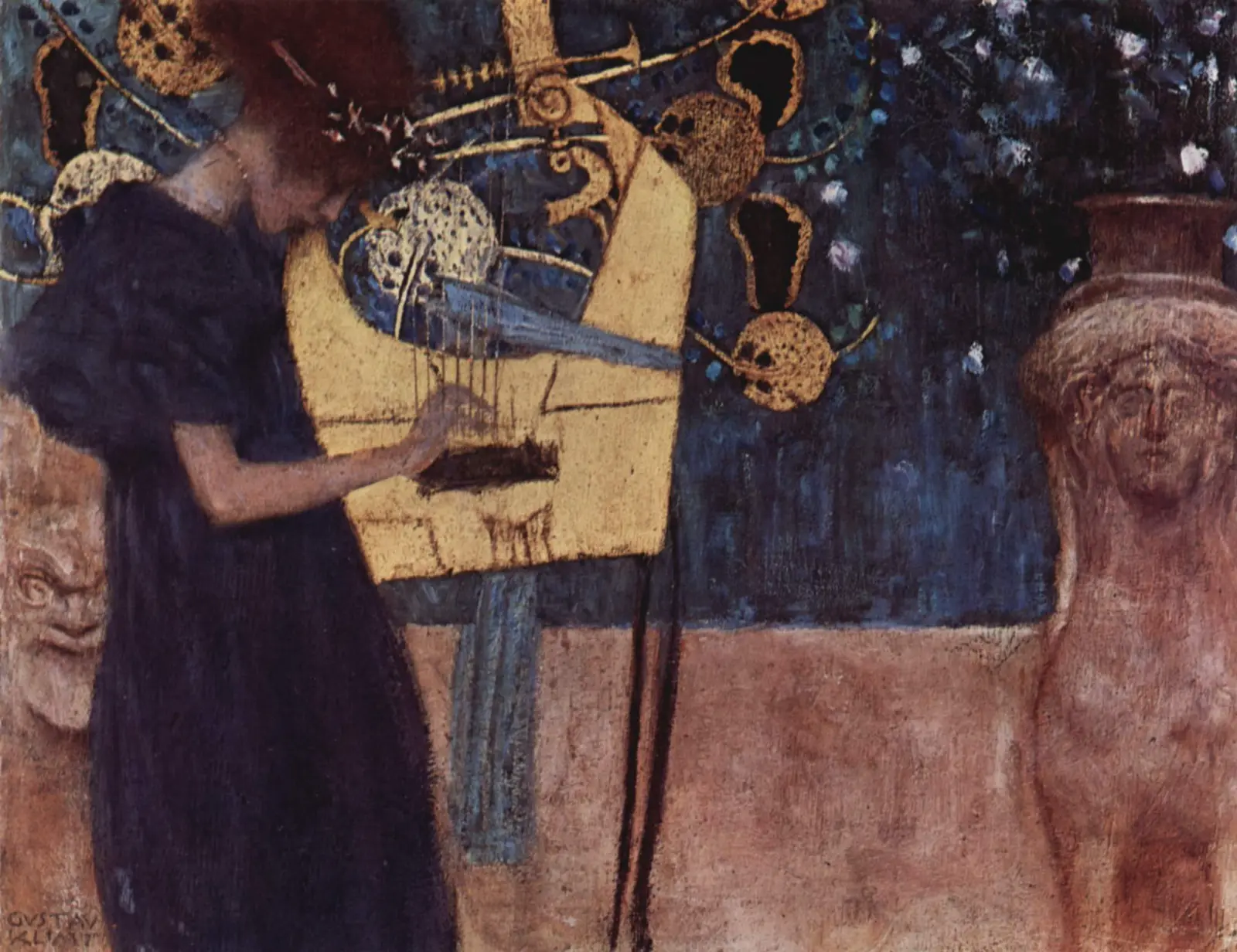
In 1892 Klimt’s father and his brother Ernst both died. The loss ended the Künstler-Compagnie in all but name, left Klimt responsible for his mother and sisters, and coincided with a turn away from the polished academic style that had made his name. Through Ernst’s widow, Helene Flöge, he also grew close to her younger sister Emilie Flöge, who would be his companion for the rest of his life.
In 1894 Klimt and Matsch were commissioned to paint the ceiling of the Great Hall of the new University of Vienna. Klimt’s share, three allegories of Philosophy, Medicine and Jurisprudence, would become the great scandal of his career.
1897–1905The Vienna Secession
In 1897 Klimt and a group of younger artists and architects broke away from the conservative Künstlerhaus association to found the Vienna Secession, with Klimt as its first president. Their exhibition hall, designed by Joseph Maria Olbrich, opened in 1898 with the motto “To every age its art, to art its freedom” above the door.
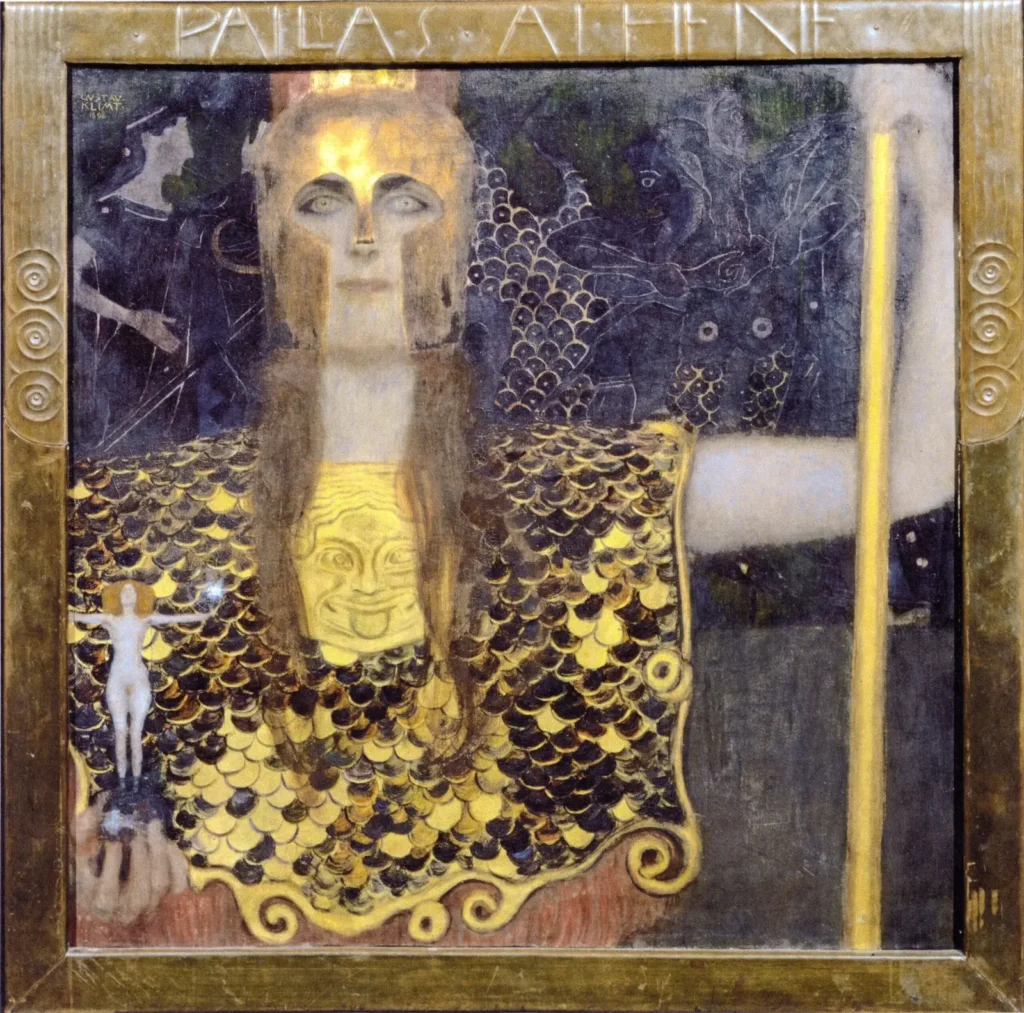
The Secession brought modern European art to Vienna and gave Klimt a stage for increasingly radical work: Pallas Athene (1898), Nuda Veritas (1899) and, in 1902, the monumental Beethoven Frieze.
Read more: The Vienna Secession · Vienna 1900 · Klimt’s patrons
1900–1905The faculty paintings scandal
When Philosophy was shown at the Secession in 1900, its swirl of naked, suffering bodies provoked a petition of protest from members of the university faculty. The same painting won a gold medal at the Paris World’s Fair that year. Medicine (1901) caused an even greater outcry, and the debate reached the Austrian parliament.
In 1905 Klimt withdrew from the commission altogether, returned his fee and bought the paintings back with the help of the collector August Lederer. He never accepted another public commission. All three faculty paintings were destroyed by fire at Schloss Immendorf in May 1945; they survive only in photographs.
Read more: The Faculty Paintings
c. 1899–1910The Golden Phase
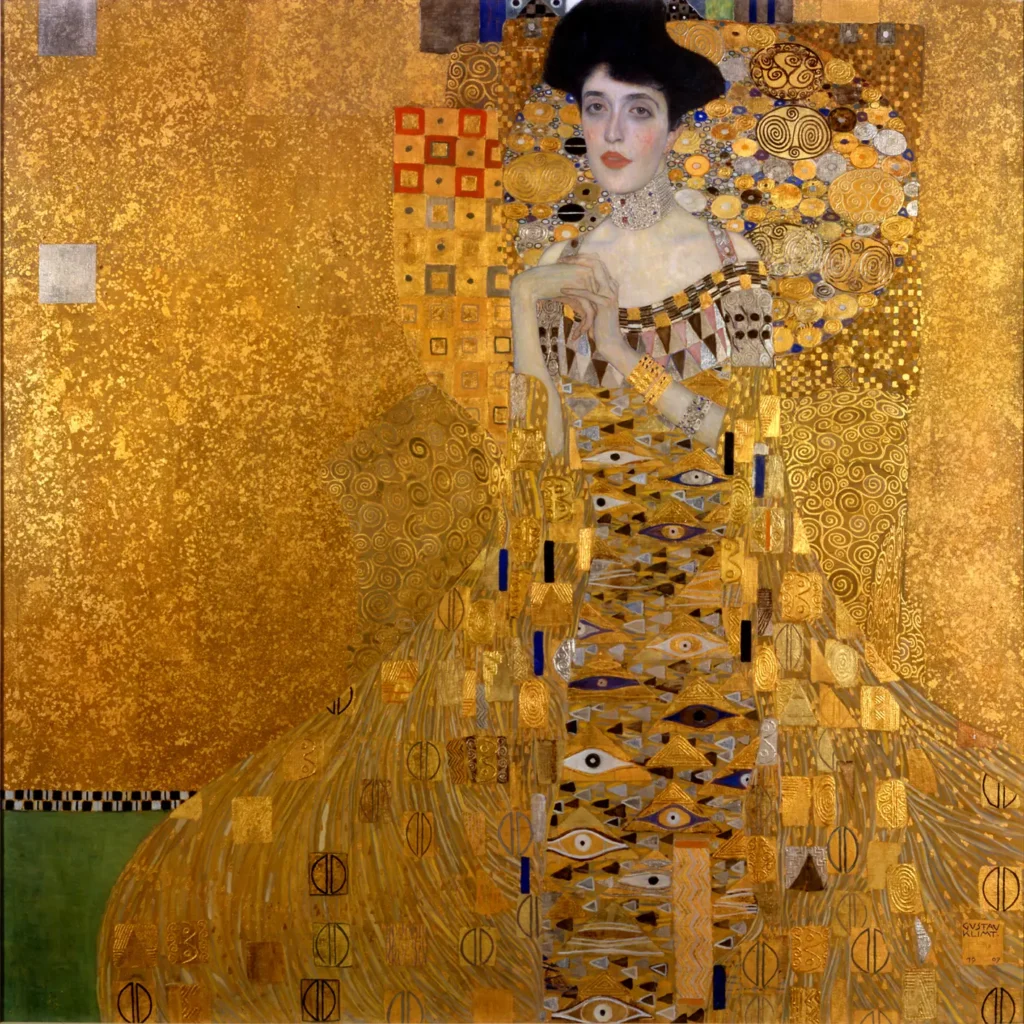
Freed from official patronage, Klimt painted for private clients, many of them from Vienna’s wealthy and largely Jewish industrial families. In these years he developed the style for which he is best known: figures and faces painted naturalistically, set against flat fields of pattern built up with real gold and silver leaf. A visit to Ravenna in 1903, where he saw the Byzantine mosaics of San Vitale, deepened the influence.
The Golden Phase produced Judith I (1901), the Portrait of Adele Bloch-Bauer I (1907) and The Kiss (1907–08), which the Austrian state bought for its modern gallery when it was shown at the 1908 Kunstschau.
Read more: The gold leaf technique · Symbols and patterns
1905–1909Leaving the Secession and the Kunstschau
Tensions inside the Secession led Klimt and a group of like-minded artists, the “Klimt group”, to leave in 1905. In 1908 they staged the Kunstschau, a vast exhibition of painting, design and applied art with a room devoted to Klimt’s work, which also introduced the young Oskar Kokoschka. Klimt had already met and begun to encourage Egon Schiele, who exhibited with the group in 1909.
1900–1916Summers at the Attersee
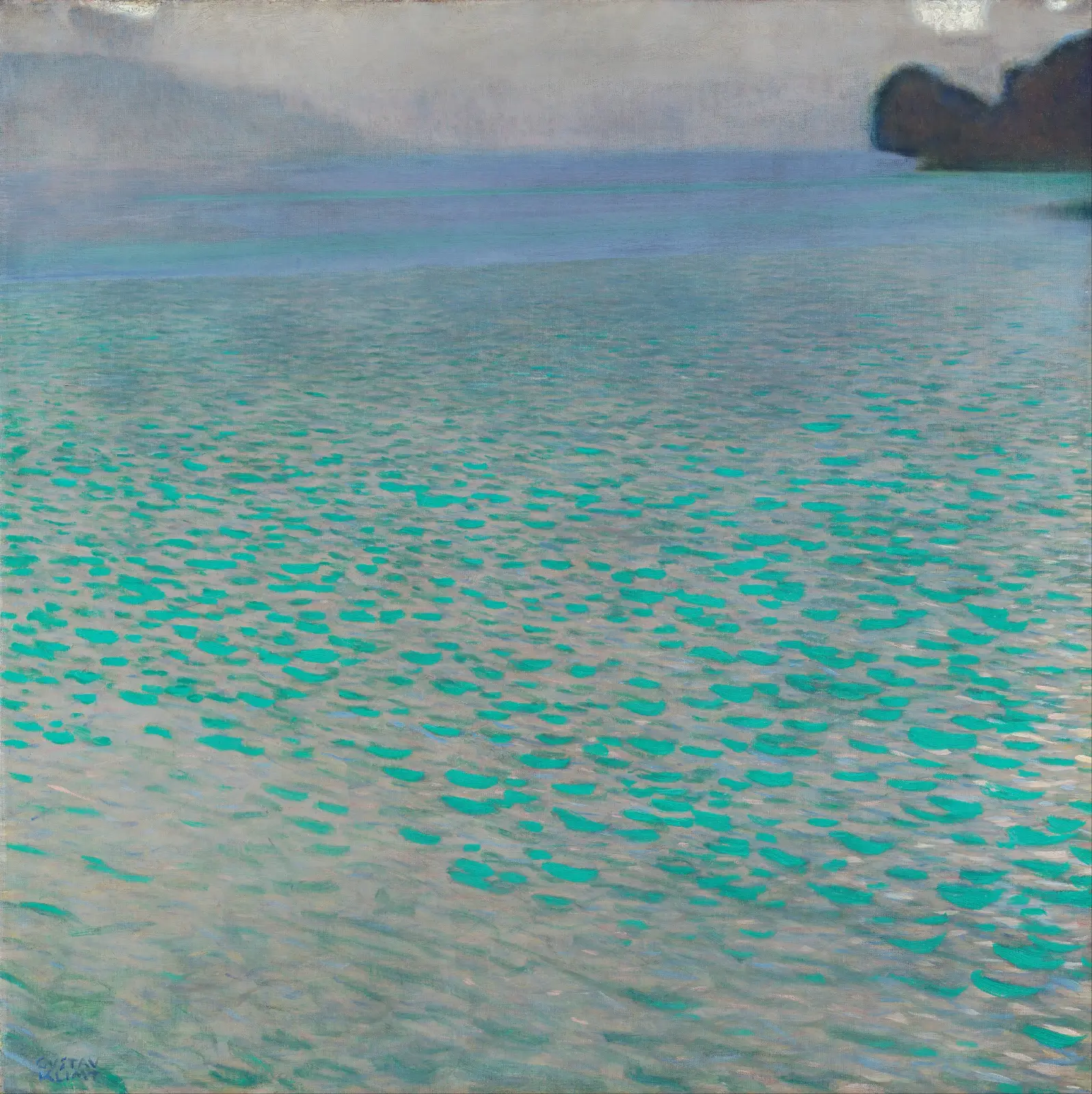
From 1900 Klimt spent most summers with the Flöge family on the Attersee, a lake in the Salzkammergut. There he painted the landscapes that make up a large share of his surviving paintings: lakes, orchards, forests and villages, almost always on a square canvas and often composed with the help of a telescope or opera glasses.
Read more: Klimt at the Attersee · The landscapes
1910–1918Late work
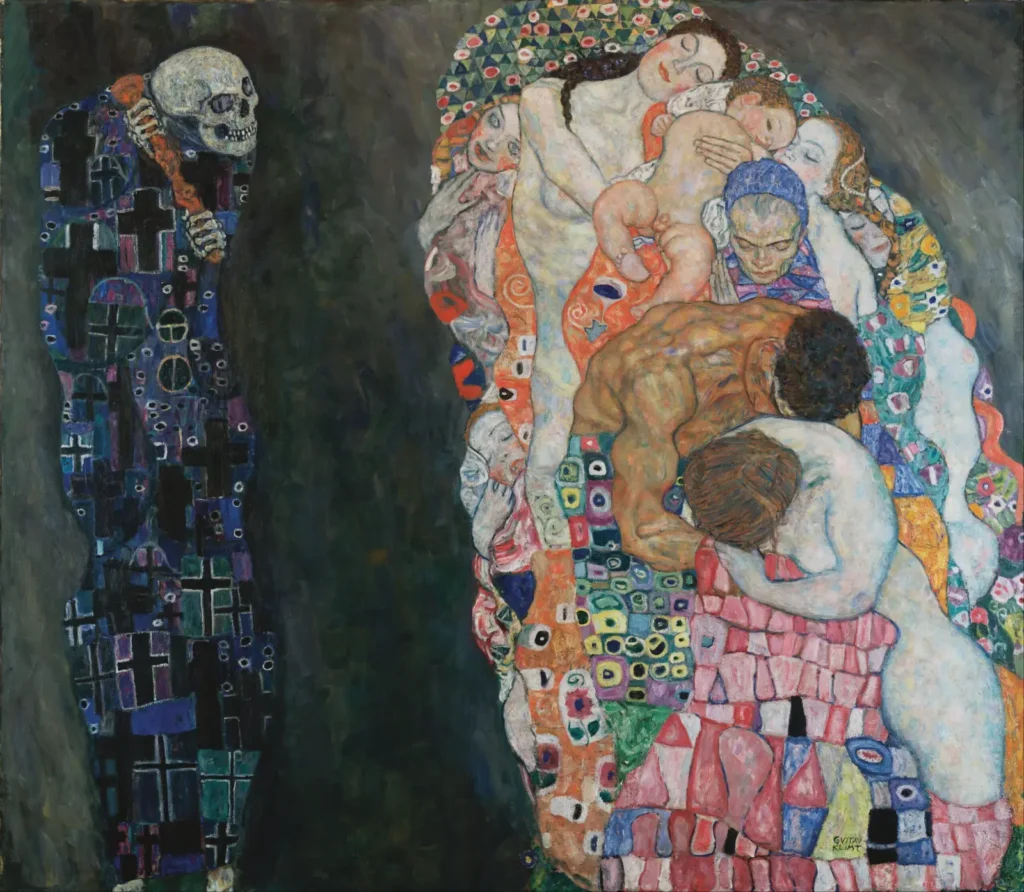
After about 1910 Klimt abandoned gold for bright, densely patterned colour, influenced by East Asian art, which he collected. In 1911 he moved into his last studio, in a garden in Hietzing (today the Klimt Villa), where he painted portraits such as Mäda Primavesi, Portrait of Elisabeth Lederer and Lady with a Fan, and allegories including Death and Life and The Maiden.
Klimt never married, but he had many relationships, and several children were born to women who modelled for him. He lived with his mother and unmarried sisters until his mother’s death in 1915.
Read more: Klimt’s drawings · The Klimt Villa
1918Death and legacy
In January 1918 Klimt suffered a stroke that left him partly paralysed, and he died in Vienna on 6 February 1918, aged 55, after contracting pneumonia. He was buried in Hietzing Cemetery. Several canvases, including The Bride and Adam and Eve, were left unfinished in his studio. His protégé Egon Schiele drew him on his deathbed and died himself of influenza eight months later.
Planning a Klimt pilgrimage to Vienna? Check the current time in Austria before you go.
Klimt’s reputation faded in the decades after his death, then rose steadily from the 1960s onwards. Today his paintings are among the most reproduced and most valuable in the world. Explore them in our painting catalogue, or find out where to see Klimt’s work.
Read more: Klimt’s death · Klimt’s legacy
 The Vienna Secession
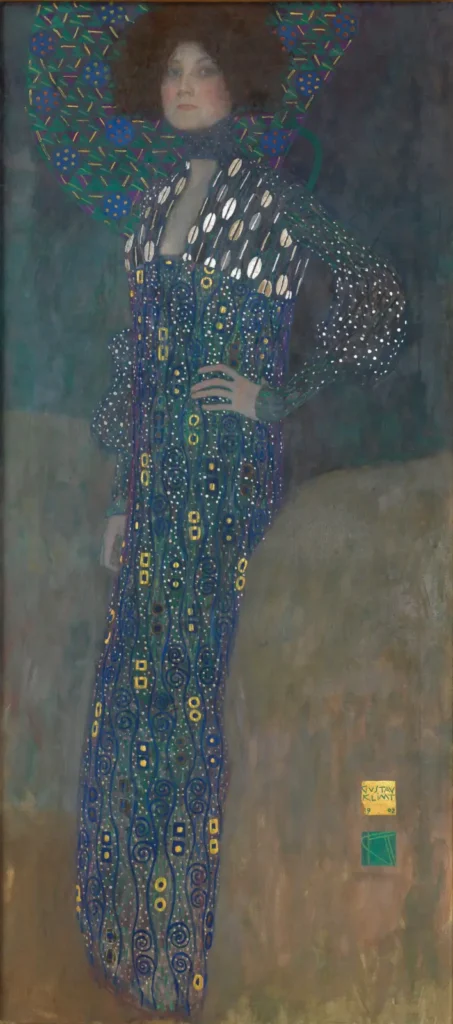 Emilie Flöge
 Klimt and Schiele