Nuda Veritas (“Naked Truth”) was painted by Gustav Klimt in 1899, at the height of the battle between the young Vienna Secession and the art establishment.
CompositionThe painting
On a very tall, narrow canvas, a naked young woman with flowing red hair stands facing us, holding up a mirror. A snake coils around her feet, and dandelion clocks drift in the dark background. Above her, in gold letters, is a quotation from the German poet Friedrich Schiller: “If you cannot please everyone with your deeds and your art, please a few. To please many is bad.”
A manifestoMeaning
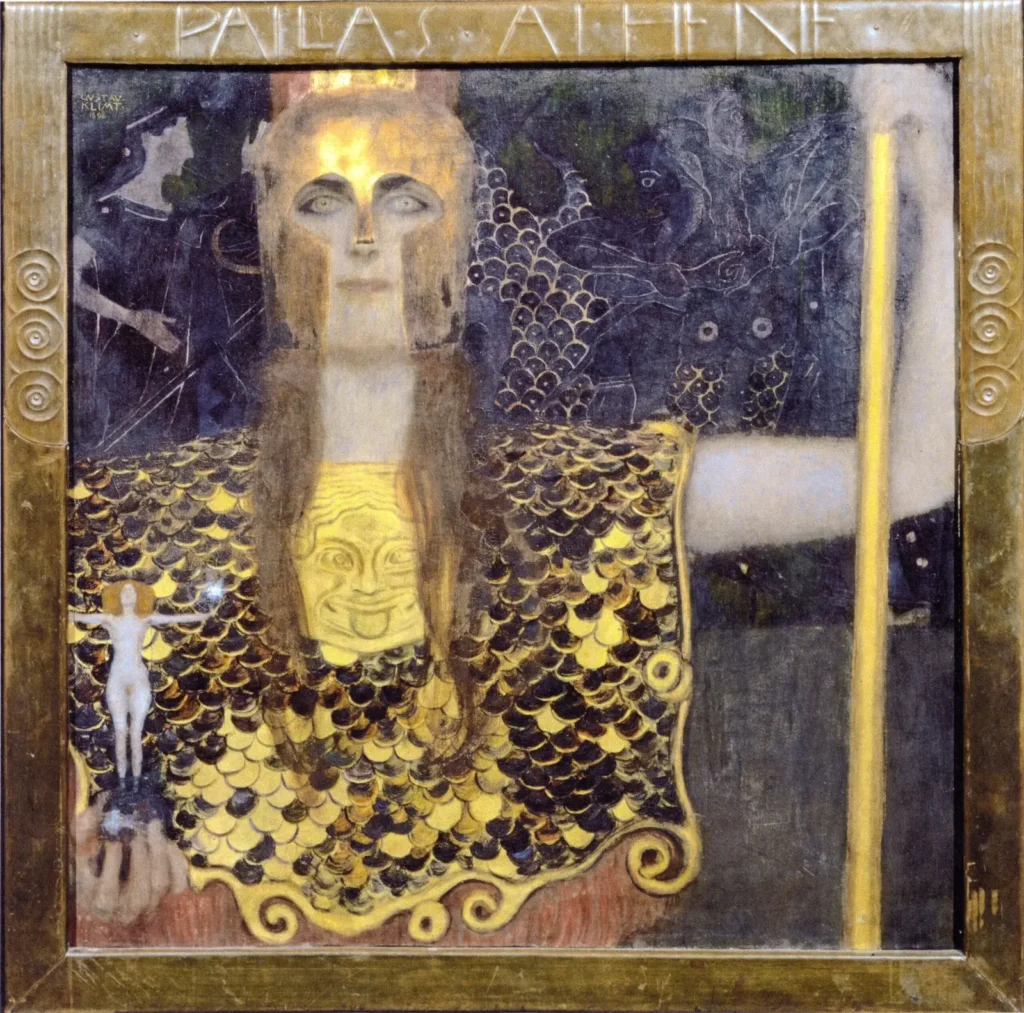
The figure of Truth holds up a mirror to modern society, showing it as it is. The snake, an ancient symbol of falsehood, is defeated at her feet. With the Schiller quotation Klimt declares that true art does not seek to please the majority. A small version of the same figure appears in the hand of his Pallas Athene (1898).
HistoryHermann Bahr
The painting belonged to the writer and critic Hermann Bahr, one of the most important supporters of the Secession. It is now in the collection of the Austrian Theatre Museum in Vienna.
New in 2026: after renovation, the Theatermuseum reopens on 2 December 2026 with Klimt. The Naked Truth, a new permanent multimedia presentation built around Nuda Veritas, shown together with Klimt’s earlier Lady with a Purple Shawl. See Klimt exhibitions 2026–2027.
InscriptionThe Schiller quotation
Above the figure, in gold letters, Klimt painted a quotation from the poet Friedrich Schiller: “Kannst du nicht allen gefallen durch deine That und dein Kunstwerk, mach es wenigen recht. Vielen gefallen ist schlimm.” In English: “If you cannot please everyone with your deeds and your art, please a few. To please many is bad.”
It was a manifesto. In 1899 Klimt and the artists of the Vienna Secession were under attack from conservative critics, and the inscription declared that true art would always offend the majority. A year later the scandal over the Faculty Paintings proved him right. An earlier version of the image, published in the Secession’s magazine Ver Sacrum in 1898, carried a different motto by Leopold Schefer.
DetailsLook closer
Nuda Veritas means “naked truth”. A young woman with flowing red hair stands frontally, completely nude, holding up a mirror towards the viewer: truth reflects us back to ourselves. Dandelion seed heads float behind her head, and at her feet a snake coils, the traditional symbol of falsehood, overcome by truth.
The painting is extremely tall and narrow, 252 × 56.2 cm, so the figure seems to rise like a column. The frontal nudity, with pubic hair shown, was itself a provocation in 1899, when academic nudes were expected to be idealised and discreet.
Quick facts10 facts about Nuda Veritas
- It was painted in 1899.
- It measures 252 × 56.2 cm.
- The title means “naked truth”.
- The woman holds a mirror up to the viewer.
- A snake, symbol of falsehood, lies at her feet.
- The inscription is a quotation from Schiller.
- An earlier version appeared in Ver Sacrum in 1898.
- It was owned by the writer and critic Hermann Bahr.
- It belongs to the Theatermuseum in Vienna.
- It is the centrepiece of the museum’s Klimt presentation opening in December 2026.
FAQFrequently asked questions
What does Nuda Veritas mean?
It means “naked truth” in Latin. The painting shows truth as a nude woman holding up a mirror, a symbol of honest self-reflection.
What does the writing on Nuda Veritas say?
A quotation from Schiller: “If you cannot please everyone with your deeds and your art, please a few. To please many is bad.”
Where is Nuda Veritas?
It belongs to the Theatermuseum in Vienna, in the Palais Lobkowitz.
Why is there a snake in Nuda Veritas?
The snake at the woman’s feet traditionally stands for falsehood or deceit, defeated by truth.
Who owned Nuda Veritas?
The writer Hermann Bahr, one of Klimt’s greatest champions, who hung it in his study.
Sources and further reading
- Austrian Theatre Museum (Theatermuseum), Vienna: collection entry for Nuda Veritas
- Tobias G. Natter (ed.), Gustav Klimt: The Complete Paintings (Taschen)
- Frank Whitford, Klimt (Thames & Hudson, World of Art)
Image: Gustav Klimt, Nuda Veritas, public domain, via Wikimedia Commons.
 Pallas Athene
 The Vienna Secession
 The faculty paintings
 All Klimt paintings