Josef Hoffmann
The architect of squares and grids, Josef Hoffmann built the settings in which Klimt’s art was shown and lived.
Josef Hoffmann (1870–1956) was born in Moravia and trained in Vienna under the great architect Otto Wagner. He was a founding member of the Vienna Secession in 1897 and co-founded the Wiener Werkstätte in 1903.
DesignA style of squares
Hoffmann loved the square and the grid so much that he was nicknamed “Quadratl-Hoffmann” (little-square Hoffmann). His furniture, metalwork and buildings use clean geometry, black-and-white contrasts and fine proportions, far from the swirling Art Nouveau of Paris.
ArchitectureKey buildings
- Purkersdorf Sanatorium (1904), near Vienna, an early landmark of modern architecture.
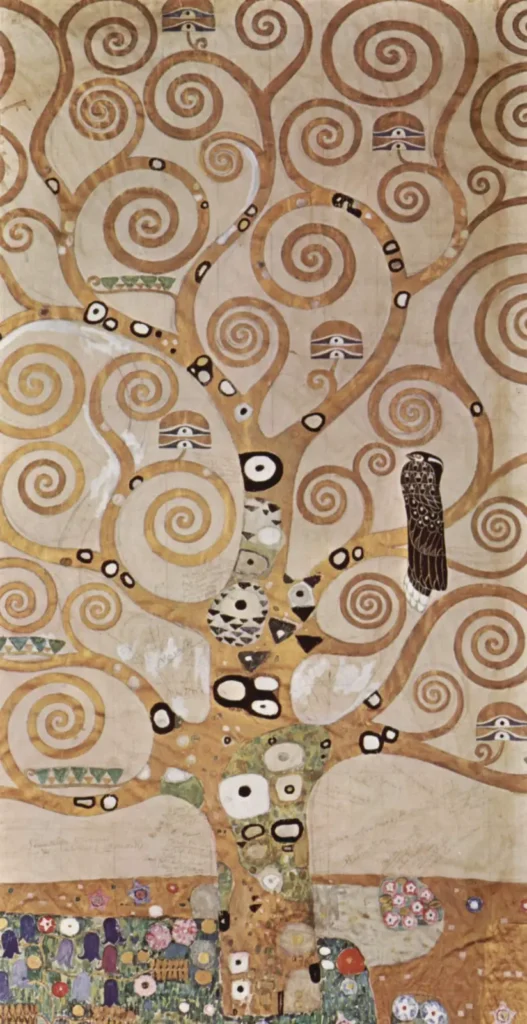
- Palais Stoclet (1905–11), Brussels, a total work of art with Klimt’s Stoclet Frieze in the dining room, now a UNESCO World Heritage Site.
- Kunstschau 1908, the temporary exhibition buildings for the show where The Kiss was first seen; see Kunstschau 1908.
- Villas for patrons such as the Primavesi family.
CollaborationHoffmann and Klimt
Hoffmann designed exhibition rooms for Klimt’s works at the Secession, including the 1902 Beethoven exhibition, and frames and furniture for his patrons and his own studio, recreated today at the Klimt Villa. Their twenty-year partnership is one of the great meetings of art and architecture.
 Wiener Werkstätte
 The Stoclet Frieze
 Koloman Moser
 Vienna 1900