The Stoclet Frieze is the mosaic decoration Gustav Klimt designed for the dining room of the Palais Stoclet in Brussels between 1905 and 1911. Its central motif, the Tree of Life, is one of his most famous images.
A total work of artThe Palais Stoclet
The Belgian financier Adolphe Stoclet and his wife Suzanne commissioned Josef Hoffmann and the Wiener Werkstätte to design their house in Brussels as a Gesamtkunstwerk, a total work of art in which architecture, furniture, fittings and decoration were all designed together. Klimt’s frieze was the jewel of the dining room. The house is a UNESCO World Heritage site and is still privately owned.
CompositionThe three panels
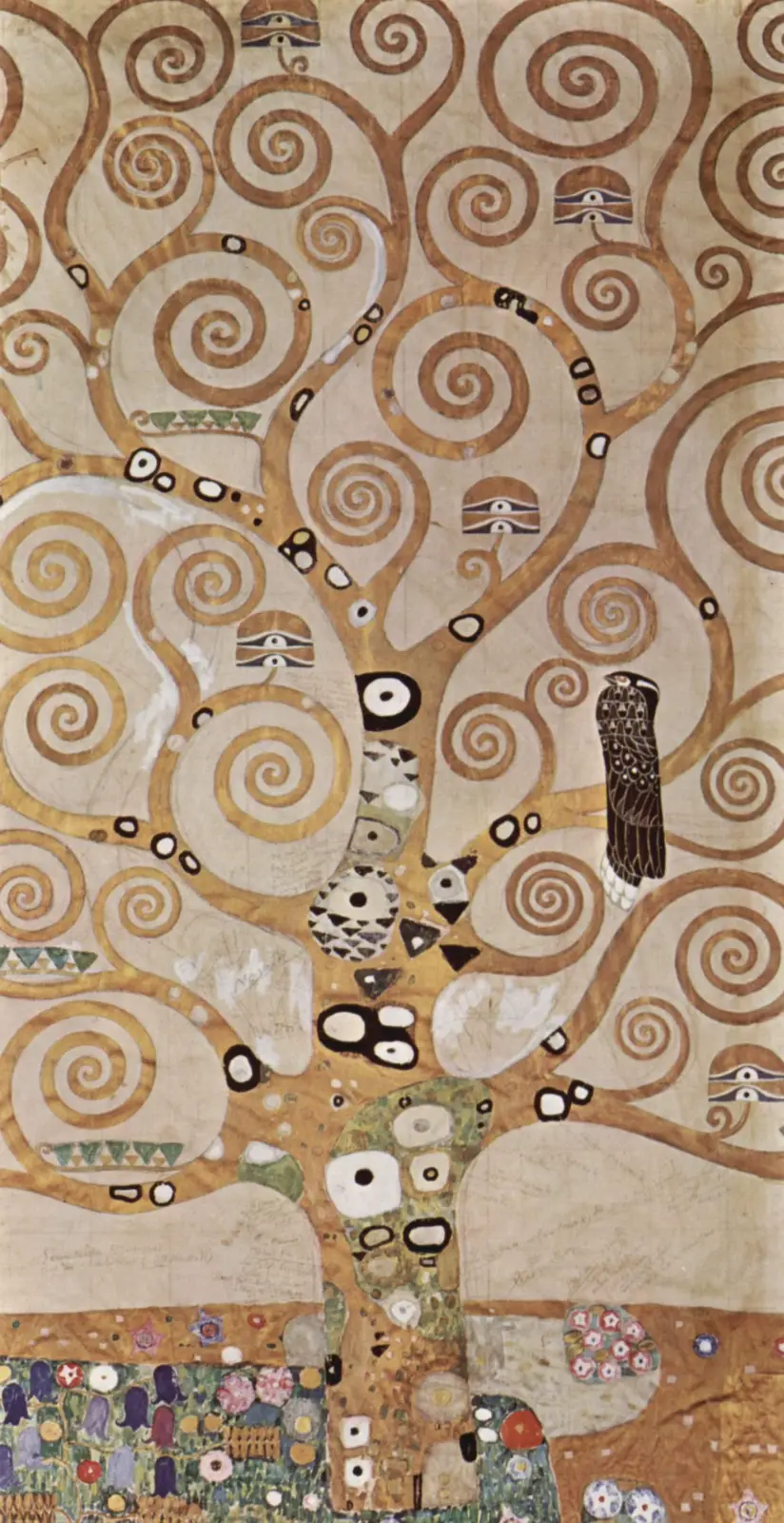
The frieze runs along three walls. On the two long walls, facing each other, are mirror-image Trees of Life with branches spiralling endlessly across the surface. On one wall a single, stiffly posed female figure in a patterned robe stands among the branches, often called Expectation; on the other an embracing couple, closely related to The Kiss, known as Fulfilment. On the short wall between them is a smaller, almost abstract panel.
MaterialsHow it was made
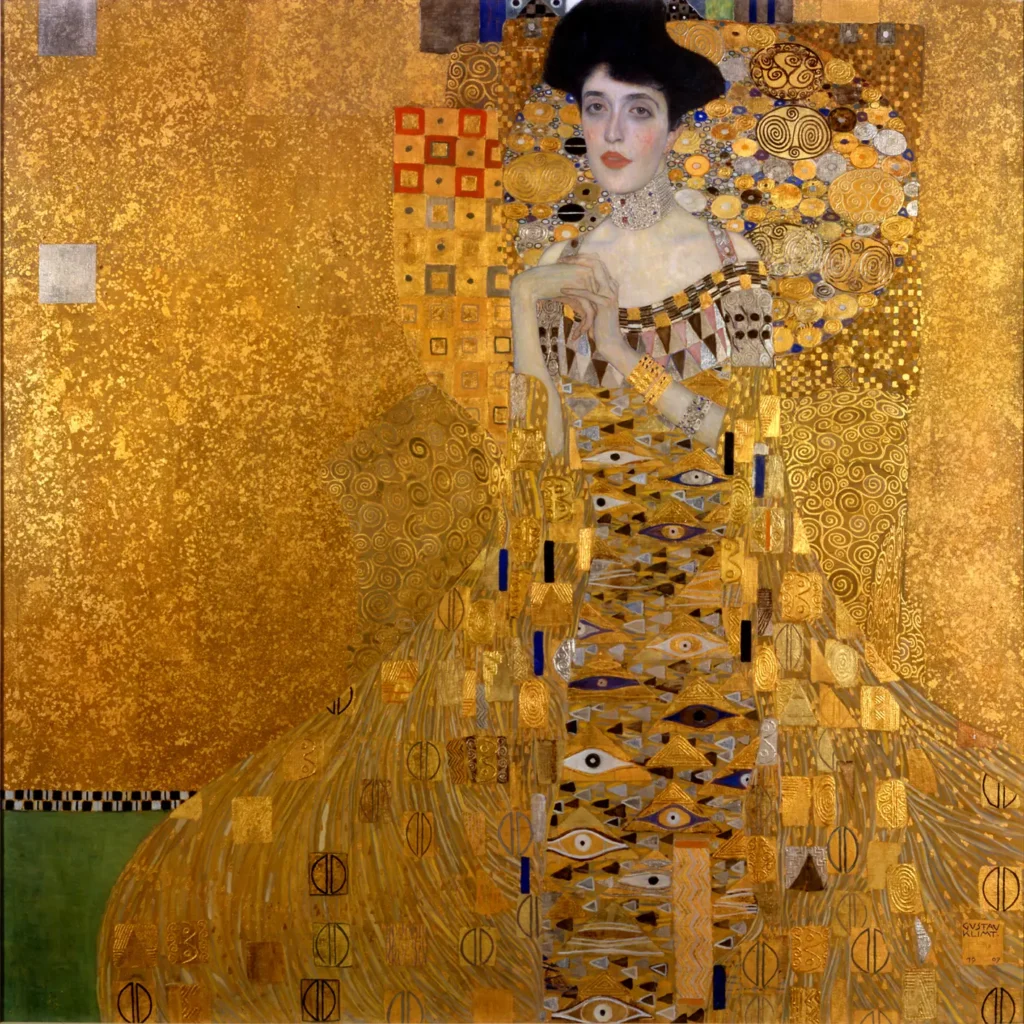
Klimt produced full-size working drawings in paint, gold and silver on paper. From these, craftsmen in Vienna assembled the mosaic using marble, glass, enamel, metal, coral and semi-precious stones, and it was installed in Brussels around 1911. The use of precious materials was the logical end of the Golden Phase.
VisitWhere to see it
The Palais Stoclet is not open to the public. Klimt’s working drawings for the frieze are in the MAK, Vienna’s Museum of Applied Arts. See our guide to where to see Klimt, or print our Tree of Life colouring page.
The Stoclet Palace is still privately owned, but if you are planning a trip to Brussels to see its famous façade, check the current time in Belgium before contacting the house.
ContextA total work of art
Adolphe Stoclet was a wealthy Belgian engineer and financier who, with his wife Suzanne, fell in love with the art of the Vienna Secession while living in Vienna. In 1905 they commissioned the architect Josef Hoffmann and the Wiener Werkstätte, the design workshop he had co-founded, to build them a house in Brussels. The result, the Palais Stoclet, completed in 1911, is one of the most complete examples of a Gesamtkunstwerk, or total work of art, ever made: architecture, furniture, lighting, cutlery, textiles and garden were all designed as one.
Klimt’s contribution was the decoration of the dining room. Its marble walls carry two long friezes facing each other across the table, and an end wall with a single panel. For Klimt it was the culmination of a decade spent exploring how painting could merge with architecture and the decorative arts, from the Beethoven Frieze onwards.
DetailsExpectation and Fulfilment
On one long wall stands a slender woman in profile, her arms angled like an Egyptian dancer, her dress covered with triangles and eye-like motifs. She is known as Expectation, or the Dancer. On the opposite wall a man and a woman embrace, wrapped together in a single patterned robe, in a pose very close to The Kiss: this is Fulfilment.
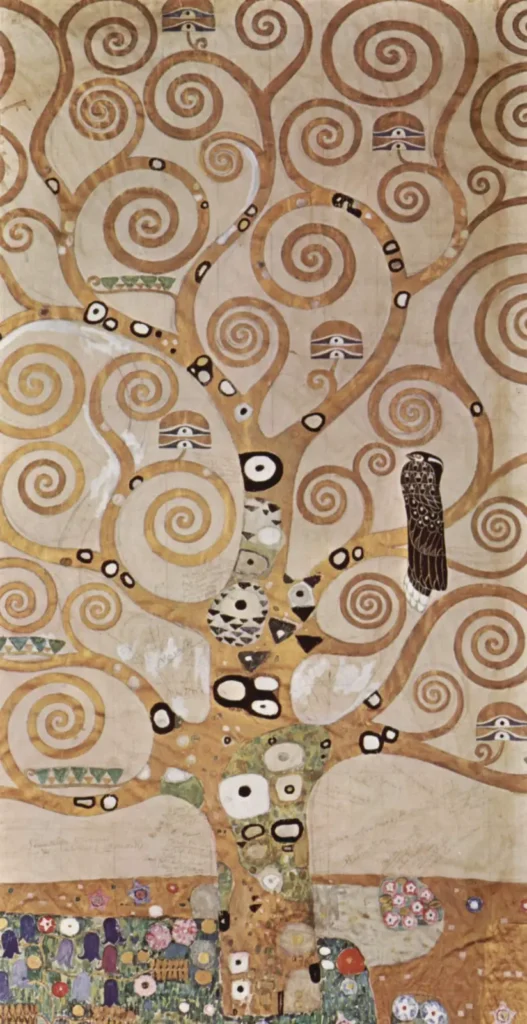
Between and around them spreads The Tree of Life, its golden spiral branches running the length of the walls, with flowers and birds below. The panel on the end wall is a largely abstract design, one of Klimt’s most daring experiments in pure ornament.
Quick facts10 facts about the Stoclet Frieze
- It was designed by Klimt between about 1905 and 1909.
- It decorates the dining room of the Palais Stoclet in Brussels.
- The house was designed by Josef Hoffmann for Adolphe and Suzanne Stoclet.
- It is a mosaic, not a painting.
- It combines marble, enamel, gilded tiles, coral, mother-of-pearl and semi-precious stones.
- It was executed by the Vienna workshop of Leopold Forstner.
- It was installed in 1911.
- Its main parts are known as Expectation, Fulfilment and The Tree of Life.
- Klimt’s full-size working cartoons are in the MAK in Vienna.
- The Palais Stoclet is a UNESCO World Heritage Site and is closed to the public.
FAQFrequently asked questions
Where is the Stoclet Frieze?
The mosaic frieze is inside the Palais Stoclet, a private house in Brussels, which is not open to the public. Klimt’s working cartoons for it are in the MAK – Museum of Applied Arts in Vienna.
What is the Stoclet Frieze made of?
It is a mosaic of marble, enamel, gilded tiles, coral, mother-of-pearl and semi-precious stones, set into the marble walls of the dining room.
Who commissioned the Stoclet Frieze?
The Belgian financier Adolphe Stoclet and his wife Suzanne, as part of their house designed by Josef Hoffmann.
Can you visit the Palais Stoclet?
No. It is still privately owned and is not open to visitors, though it can be seen from the street in Brussels.
How is the Tree of Life connected to the Stoclet Frieze?
The Tree of Life is the central motif of the frieze, its golden branches running along both long walls of the dining room.
Sources and further reading
- MAK, Vienna: Stoclet Frieze working drawings
- Tobias G. Natter (ed.), Gustav Klimt: The Complete Paintings (Taschen)
- Frank Whitford, Klimt (Thames & Hudson, World of Art)
- Klimt Foundation, Vienna: Gustav Klimt Database
Image: Gustav Klimt, The Stoclet Frieze, public domain, via Wikimedia Commons.
 The Tree of Life
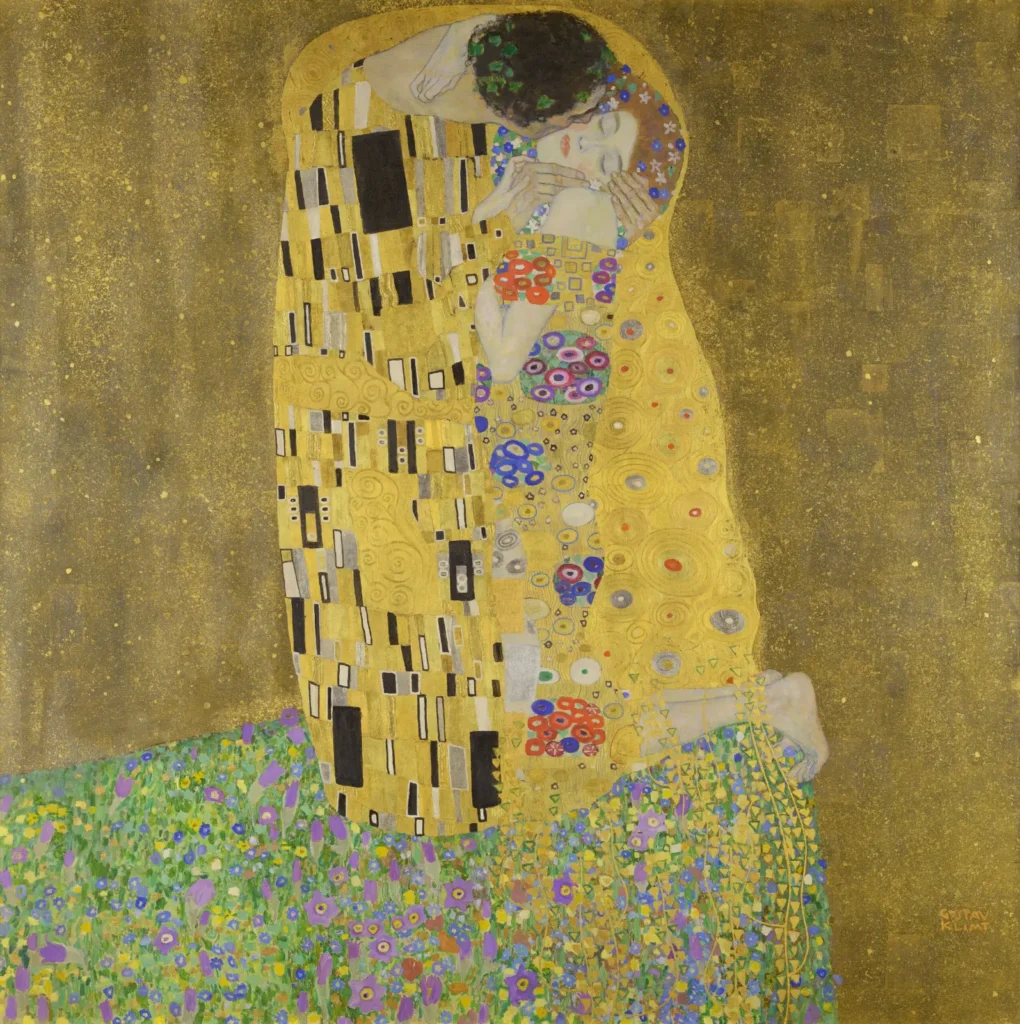 The Kiss
 The Wiener Werkstätte
 The Golden Phase