The Sunflower (Die Sonnenblume) was painted at the Attersee in 1907, at the height of Klimt’s Golden Phase.
CompositionThe painting
A single sunflower rises in the centre of the square canvas, its drooping leaves falling around the stem like a long dress, its golden head bowed. At its feet a carpet of flowers spreads out in pinks, blues and whites. The background is a dark, dense wall of green.
InterpretationA hidden figure?
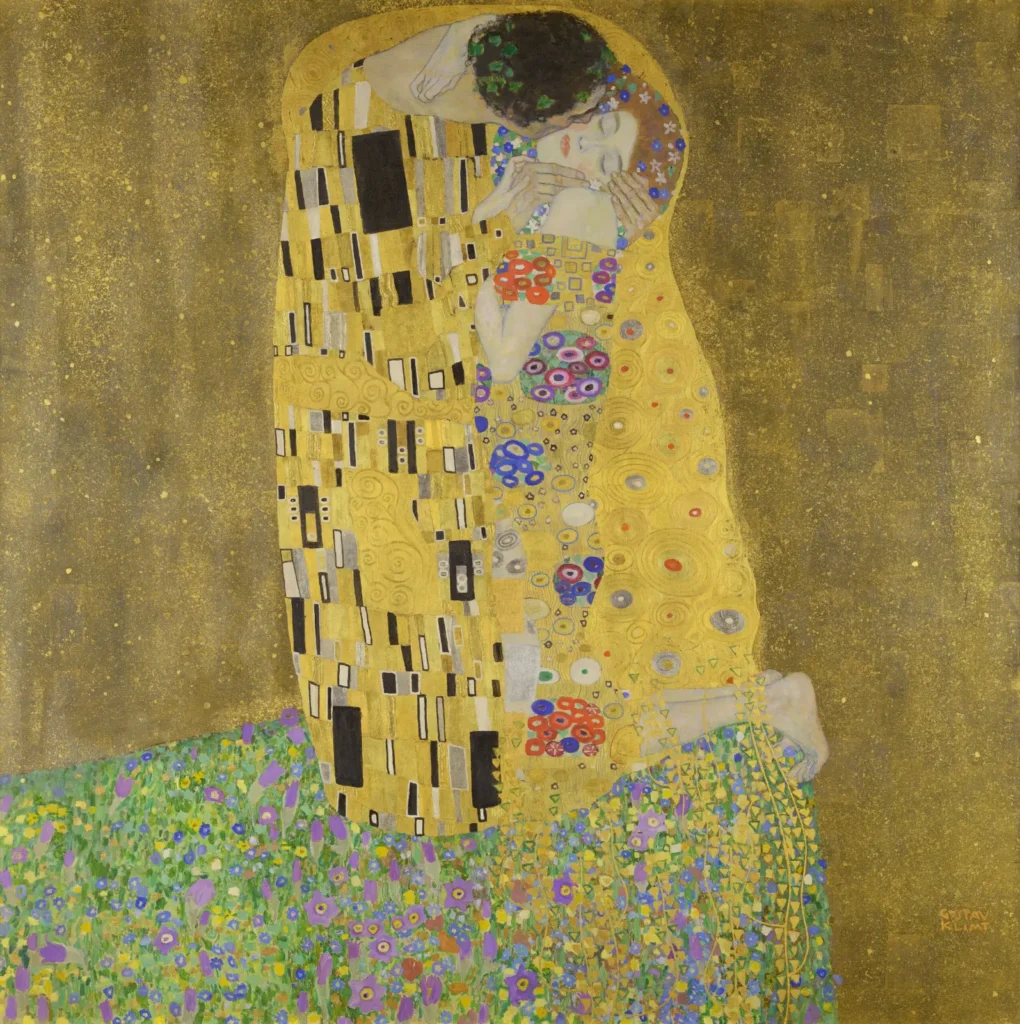
Writers have often compared the sunflower to the embracing couple in The Kiss, painted the same year: a tall shape in a patterned robe, standing on a meadow of flowers at the edge of a void. Klimt never explained it, but the resemblance makes the plant feel almost human.
VisitWhere to see it
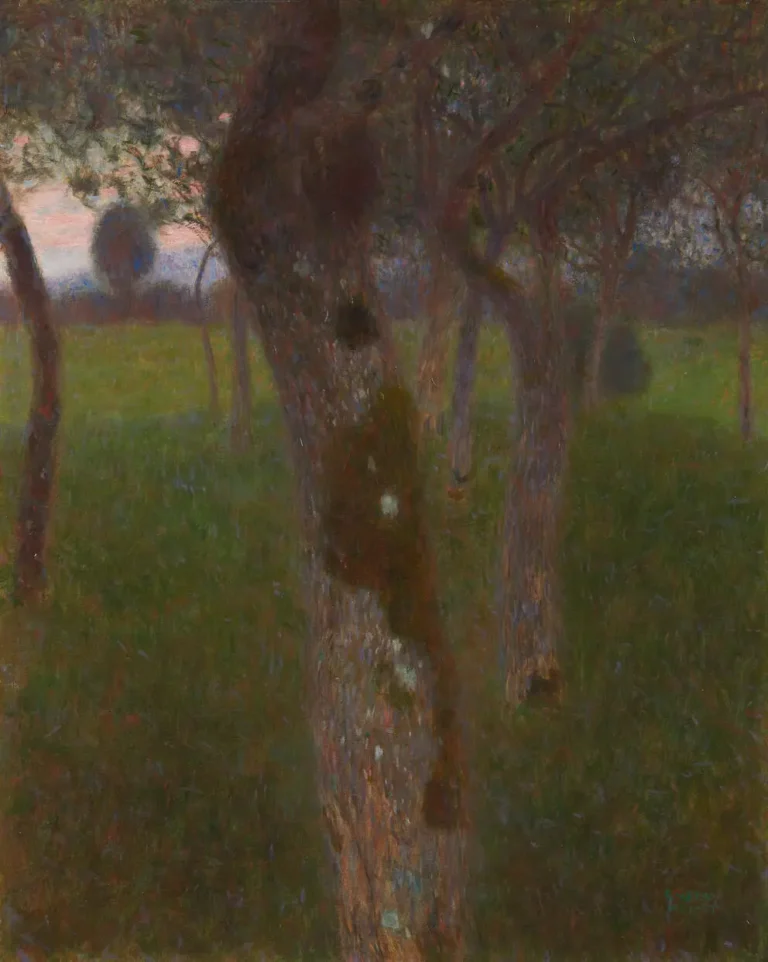
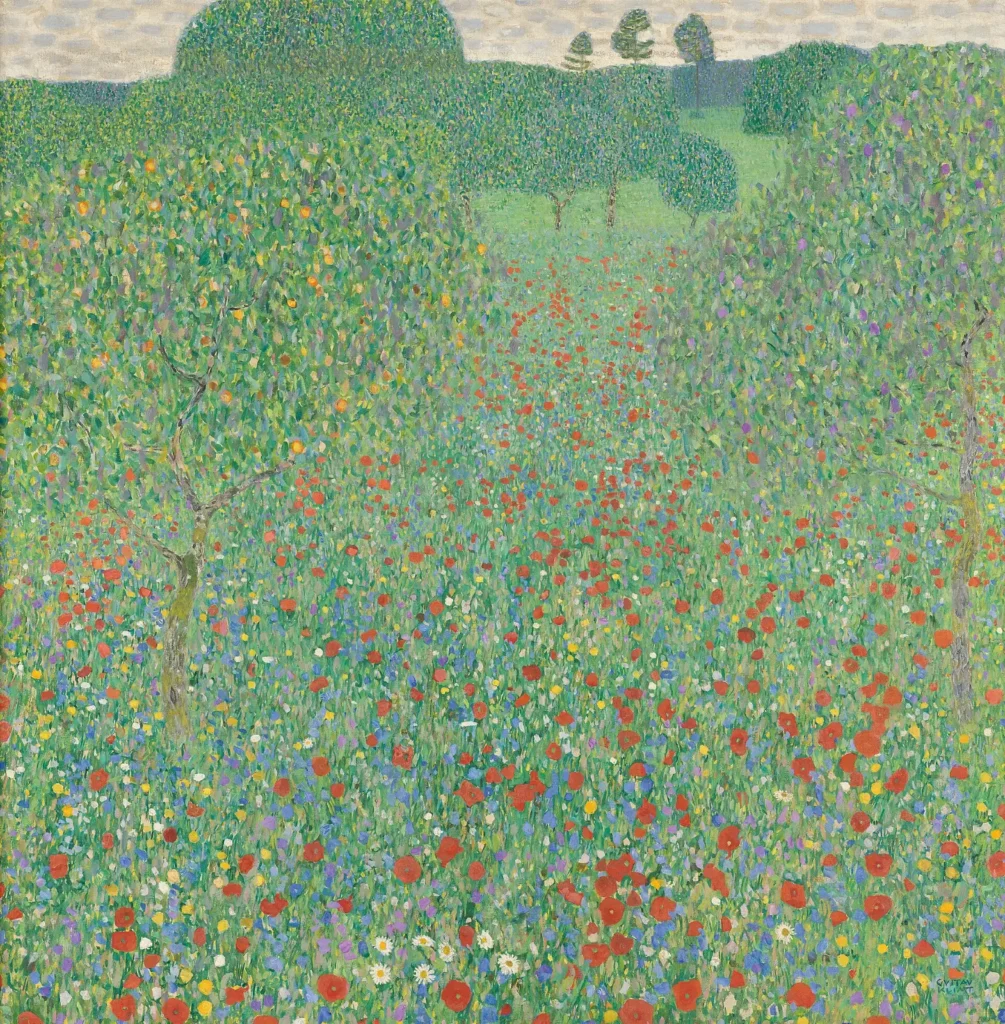
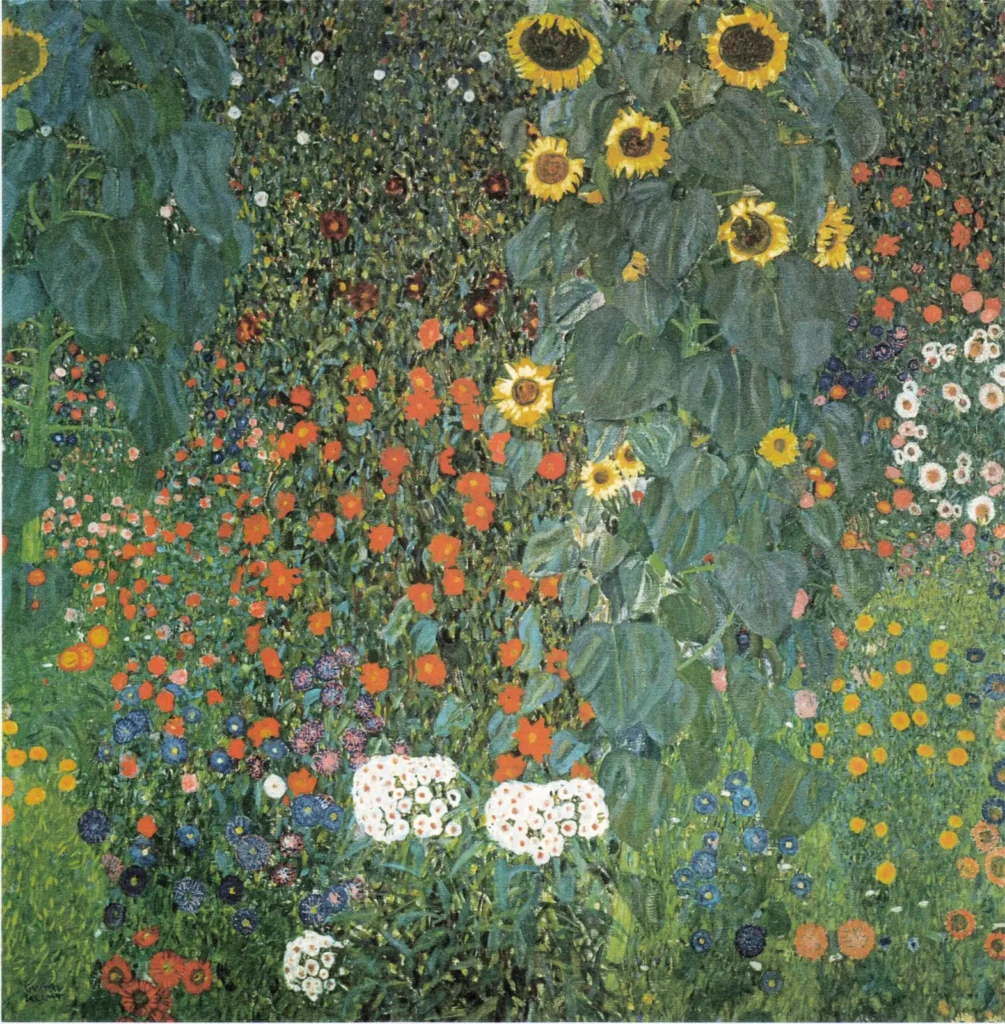
The painting is in the Belvedere in Vienna. Compare it with Farm Garden with Sunflowers and Poppy Field, painted the same summer.
ContextKlimt’s flowers
Flowers run through all of Klimt’s work. The lovers in The Kiss kneel on a meadow of flowers, Adele Bloch-Bauer’s second portrait is set against blossoms, and his late women stand in front of lotus and peony patterns. In his Attersee summers he painted flowers for their own sake, in garden pictures such as Farm Garden with Sunflowers, Bauerngarten and Poppy Field.
The Sunflower is different from those gardens. Instead of a bed of mixed flowers, it isolates a single tall plant in the centre of the square canvas, surrounded by a carpet of smaller blooms. The stem and its drooping leaves form a long, dress-like shape, crowned by the flower head, which is why so many viewers see a figure in it.
ComparisonKlimt’s sunflower and Van Gogh’s
It is hard to think of sunflowers in art without thinking of Vincent van Gogh, whose series of sunflowers in a vase, painted in Arles in 1888–89, are among the most famous still lifes ever made. Klimt certainly knew Van Gogh’s work: the Vienna Secession showed his paintings in 1903, and Viennese collectors bought them.
But the two artists’ sunflowers could hardly be more different. Van Gogh’s are cut flowers, thickly painted, wilting and full of energy. Klimt’s is a living plant in a garden, calm, upright and decorative, its leaves arranged almost like the folds of a gown. Where Van Gogh is expressive, Klimt is ornamental.
Quick facts10 facts about The Sunflower
- It was painted in 1907–08, the same years as The Kiss.
- It measures 110 × 110 cm, Klimt’s usual landscape format.
- It shows a single sunflower plant in a garden of smaller flowers.
- The stem and leaves form a tall, robe-like shape.
- Many viewers read it as a disguised human figure.
- Some have suggested it is a hidden portrait of Emilie Flöge.
- It is one of Klimt’s Attersee garden paintings.
- It is in the Belvedere in Vienna.
- It is often compared with Van Gogh’s sunflowers, though the two are very different.
- It is related to Farm Garden with Sunflowers of 1906, also in the Belvedere.
FAQFrequently asked questions
Where is Klimt’s The Sunflower?
It is in the Belvedere in Vienna.
When did Klimt paint The Sunflower?
In 1907–08, during his Golden Phase.
Is there a person hidden in The Sunflower?
Not literally, but the tall plant with its drooping leaves is shaped so much like a standing figure in a long dress that many people see one. Some have linked it to Emilie Flöge or to the lovers in The Kiss.
Did Klimt paint other sunflowers?
Yes. Farm Garden with Sunflowers (1906) shows a group of sunflowers among other plants, and sunflowers appear in several of his garden paintings.
How big is The Sunflower?
110 × 110 cm, about 43 inches square.
Sources and further reading
- Tobias G. Natter (ed.), Gustav Klimt: The Complete Paintings, Taschen
- Frank Whitford, Klimt, Thames & Hudson
- Klimt Foundation, Gustav Klimt Database
Image: Gustav Klimt, The Sunflower, public domain, via Wikimedia Commons.
 The Kiss
 Poppy Field
 Farm Garden with Sunflowers
 Klimt’s landscapes