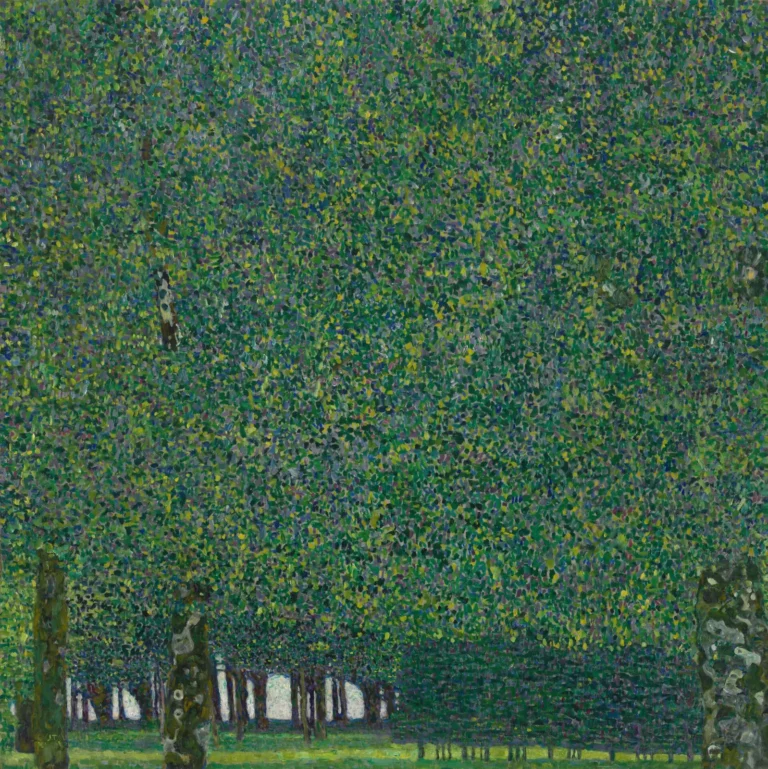
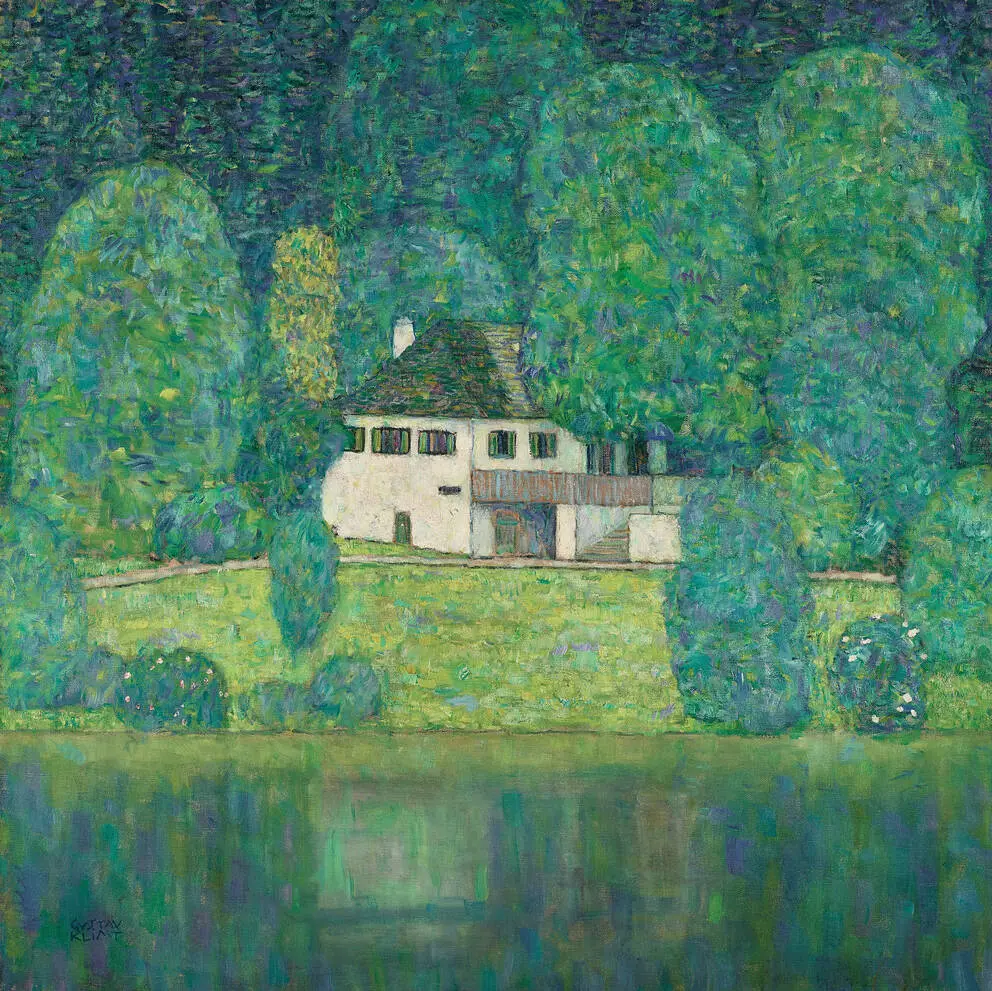
Litzlberg on the Attersee shows the hills on the shore of the lake as a vertical wall of trees, with a narrow band of houses and water at the bottom. It is one of the most richly patterned of Klimt’s late landscapes.
The painting
The hillside is built from thousands of small touches of green, blue and yellow, with a pale meadow cutting across the upper part. The village and lake are squeezed into the lowest strip of the canvas. He often painted the opposite shore through binoculars or a telescope, which flattens distance and stacks buildings one above another like a tapestry. Sotheby’s compared the surface to folk tapestry and stained glass.
Looted and returned
The painting was bought from Klimt by the Zuckerkandl family and later belonged to Amalie Redlich, Viktor Zuckerkandl’s sister. She was deported by the Nazis in 1941 and murdered, and the picture was seized. After the war it passed through Galerie Welz in Salzburg to the city’s Museum der Moderne (Rupertinum).
In 2011 the museum restituted it to Redlich’s grandson, Georges Jorisch, who had remembered it from his childhood home. On 2 November 2011 it sold at Sotheby’s New York for $40.4 million. See more in our restitution tracker and auction results.
ExploreRelated works
If you are interested in Litzlberg on the Attersee, these works by Klimt make good companions:
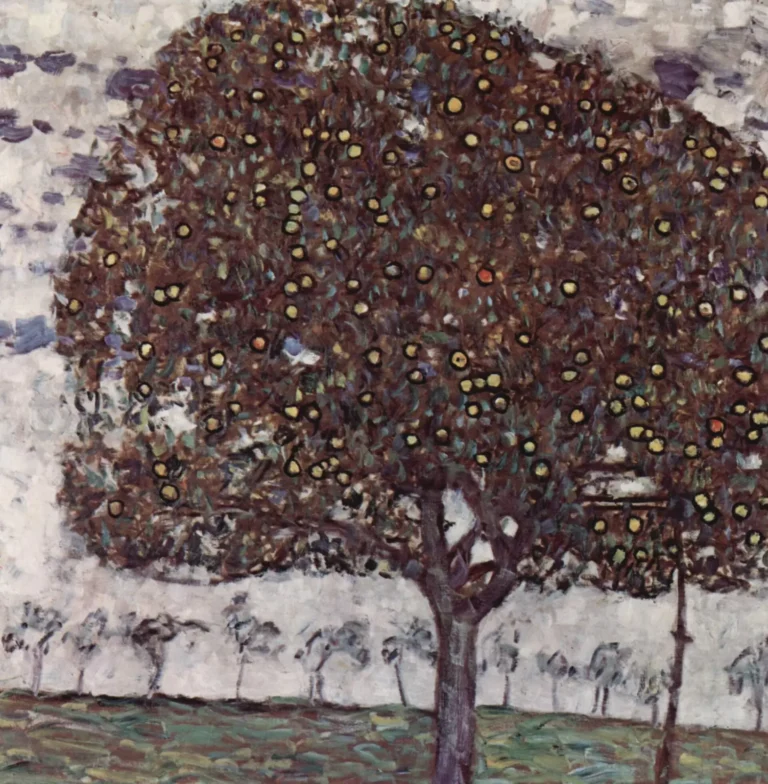
- Apple Tree I (c. 1912): another landscape.
- Apple Tree II (1916): another landscape.
- Avenue to Schloss Kammer Park (1912): another landscape.
- Church in Cassone (1913): another landscape.
Browse every known work in our catalogue of Klimt’s paintings, or find out where every Klimt painting is today.
FAQFrequently asked questions
Where is Litzlberg on the Attersee today?
Litzlberg on the Attersee is in a private collection, so it is not on permanent public display, though it is sometimes lent to exhibitions.
When did Gustav Klimt paint Litzlberg on the Attersee?
Klimt painted Litzlberg on the Attersee around 1914–15. It belongs to his late period, from about 1910 until his death in 1918, when colour replaced gold.
How big is Litzlberg on the Attersee?
It measures 110 × 110 cm, or about 43 × 43 inches. The square format was a favourite of Klimt’s, used for almost all his landscapes and several portraits.
What materials did Klimt use for Litzlberg on the Attersee?
It is oil on canvas.
Has Litzlberg on the Attersee been sold?
Yes: $40.4m, Sotheby’s New York, 2 November 2011. See our Klimt auction results for other sales.
Sources and further reading
- Tobias G. Natter (ed.), Gustav Klimt: The Complete Paintings, Taschen
- Frank Whitford, Klimt, Thames & Hudson
- Klimt Foundation, Gustav Klimt Database
Image: Gustav Klimt, Litzlberg on the Attersee, public domain, via Wikimedia Commons.
 Restitution tracker
 Auction results
 Litzlbergkeller
 Klimt landscapes