Sonja Knips
A young baroness whose 1898 portrait launched Klimt’s career as Vienna’s most sought-after painter of women.
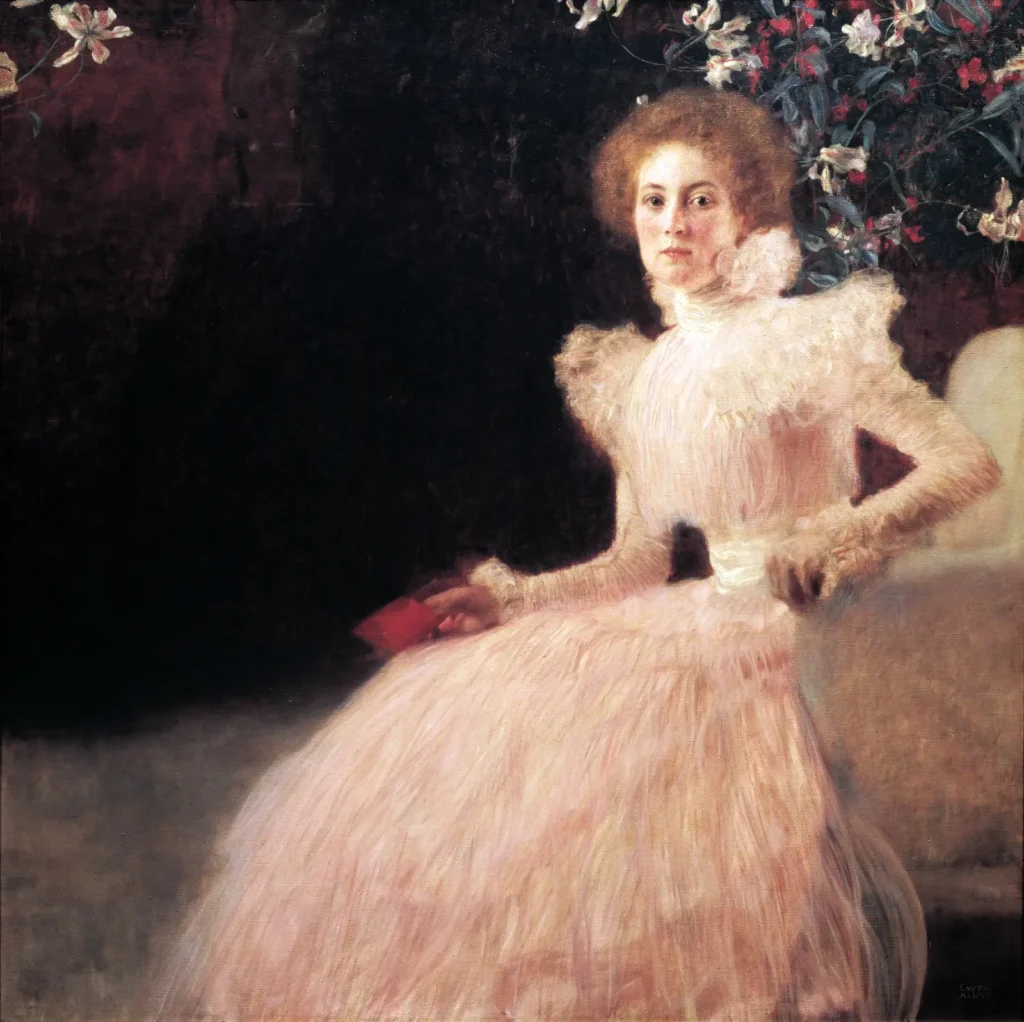
Sonja Knips, born Sophie Potier des Echelles, married the industrialist Anton Knips in 1896. Two years later Klimt painted her in pink tulle, and the picture became his first great society portrait.
| Born | Sophie Potier des Echelles, 1873 |
|---|---|
| Died | 1959 |
| Married | Anton Knips, 1896 |
| Portrait | 1897–98, oil on canvas, square format |
| Where to see it | Belvedere, Vienna |
LifeWho she was
Born into a family of the Austrian minor nobility, Sonja married Anton Knips, whose family owned iron works. The couple became loyal supporters of modern Viennese design: they commissioned furniture and objects from the Wiener Werkstätte, and Josef Hoffmann later designed a house for them in Vienna’s 19th district. She kept close ties to the Secession artists for the rest of her life.
The paintingThe portrait
Klimt placed her off-centre in a square canvas, leaning forward in a chair against a dark background, holding a small red notebook. The pale, dissolving dress shows his debt to Whistler and the Impressionist portrait, while the square format, which Klimt would use for almost all his landscapes, was new. The painting was shown at the second Secession exhibition in 1898 and made his name among wealthy Viennese families looking for a modern portraitist.
See the full entry on our Portrait of Sonja Knips page and the other works of the Secession years.
FAQFrequently asked questions
Who was Sonja Knips?
Sonja Knips (1873–1959), born Sophie Potier des Echelles, was a Viennese baroness and patron of modern design. Klimt painted her portrait in 1897–98.
Where is the Portrait of Sonja Knips?
In the Belvedere, Vienna.
Why does the portrait matter?
It was Klimt’s first major commissioned portrait of a society woman and was shown at the second Secession exhibition in 1898, establishing him as a portrait painter.
 The Secession years
 Klimt’s models and muses
 Klimt’s patrons