Hope I (1903) is one of Gustav Klimt’s most daring paintings: a full-length nude of a pregnant woman, at a time when such an image was considered unthinkable in public art.
CompositionThe painting
The woman stands in profile with her belly forward and her red hair crowned with flowers, gazing calmly at the viewer. Above and behind her, in a dark space, are sinister figures: a skull, a monstrous creature and grotesque faces representing death, sickness and misery. Her calm confidence, against these threats, is the hope of the title.
ReceptionToo shocking to show
The painting was intended for the Secession’s Klimt exhibition of 1903, but it was withheld because of fears that it would cause a scandal, especially after the attacks on the Faculty Paintings. It was not shown publicly until the Kunstschau of 1909. Klimt later returned to the theme in the gentler, clothed Hope II, using the same model, Herma.
VisitWhere to see it
Hope I is in the National Gallery of Canada in Ottawa, one of the few Klimt paintings in Canada. See our guide to where to see Klimt.
DetailsLook closer
Hope I shows a young woman with a mass of red hair, standing in profile, naked and heavily pregnant. She looks straight out at the viewer, her hands resting on her body. Around and behind her, in a dark blue space, float sinister figures: a skull, grotesque faces and other shadowy shapes.
The contrast between the luminous pregnant body and the threatening shapes around it is the heart of the painting. It shows hope for new life surrounded by the dangers of sickness, poverty and death, a theme Klimt had explored in Medicine. The model is recorded as Herma, one of Klimt’s favourite models, who was pregnant at the time.
HistoryHidden behind doors
Hope I was too provocative for public display. When Klimt planned to show it at his retrospective at the Vienna Secession in 1903, the minister of education reportedly asked that it be withheld, fearing it would harm the campaign for the Faculty Paintings.
The painting was bought by Fritz Waerndorfer, a wealthy patron and co-founder of the Wiener Werkstätte, who kept it in a frame with doors that could be closed when guests came. It was finally shown publicly at the Kunstschau of 1909. In 1970 it was acquired by the National Gallery of Canada in Ottawa, where it remains one of the museum’s best-known works.
Quick facts10 facts about Hope I
- It was painted in 1903.
- It measures 189.2 × 67 cm.
- It shows a naked, pregnant woman in profile.
- The model is recorded as Herma, one of Klimt’s models.
- A skull and grotesque figures lurk behind her.
- It was withheld from Klimt’s 1903 Secession retrospective.
- Fritz Waerndorfer kept it behind doors in his home.
- It was first publicly shown at the Kunstschau in 1909.
- It is in the National Gallery of Canada in Ottawa.
- It was followed by Hope II (1907–08), now at MoMA.
FAQFrequently asked questions
Where is Hope I by Klimt?
It is in the National Gallery of Canada in Ottawa.
Why was Hope I controversial?
It showed a naked pregnant woman, a taboo subject at the time, surrounded by images of death and danger. It was withheld from exhibition in 1903.
Who was the model for Hope I?
A model called Herma, who often posed for Klimt and was pregnant at the time.
What does Hope I mean?
It shows the hope of new life threatened by death, illness and misfortune, symbolised by the dark figures around the pregnant woman.
What is the difference between Hope I and Hope II?
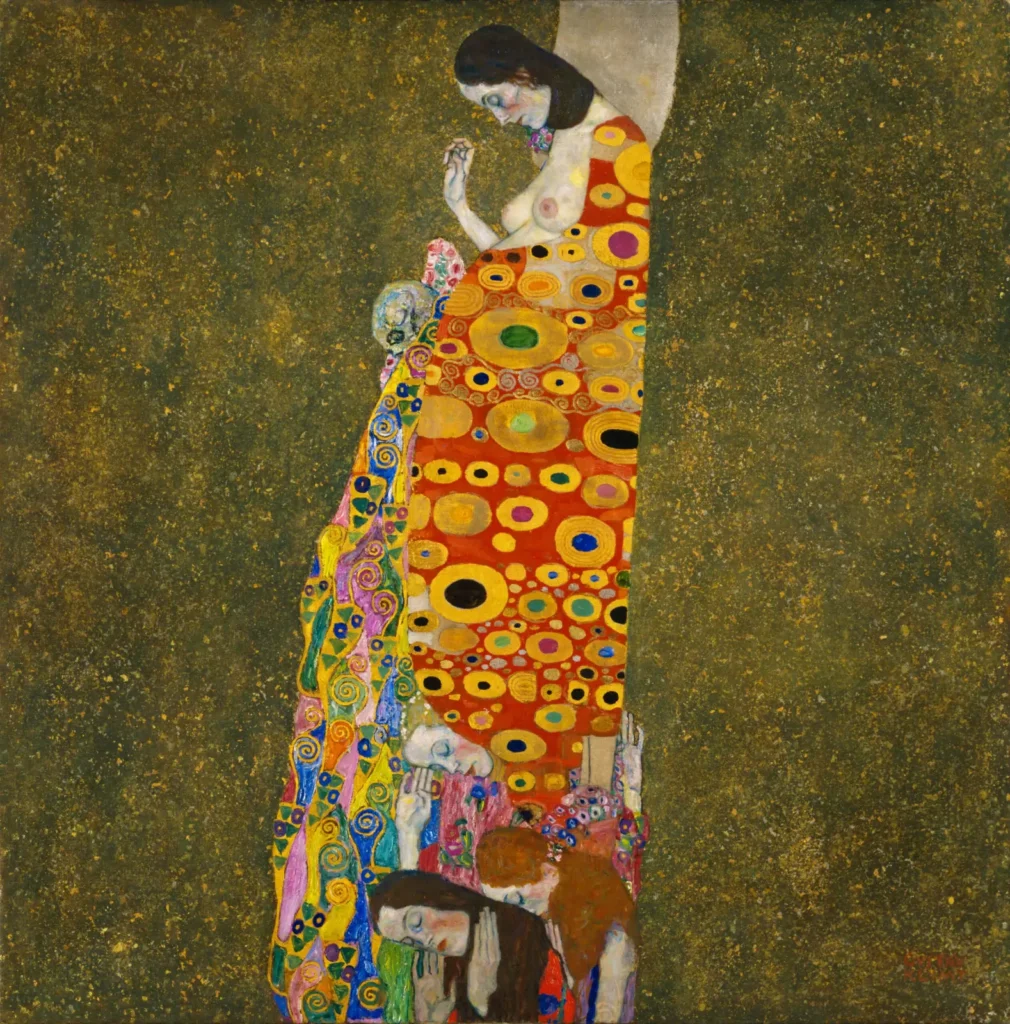
Hope I (1903) is a naked figure surrounded by menacing creatures; Hope II (1907–08) shows the woman clothed in a golden robe, in a calmer composition with a small skull.
Sources and further reading
- Tobias G. Natter (ed.), Gustav Klimt: The Complete Paintings (Taschen)
- Frank Whitford, Klimt (Thames & Hudson, World of Art)
- Klimt Foundation, Vienna: Gustav Klimt Database
Image: Gustav Klimt, Hope I, public domain, via Wikimedia Commons.
 Hope II
 The Faculty Paintings
 Death and Life
 All Klimt paintings