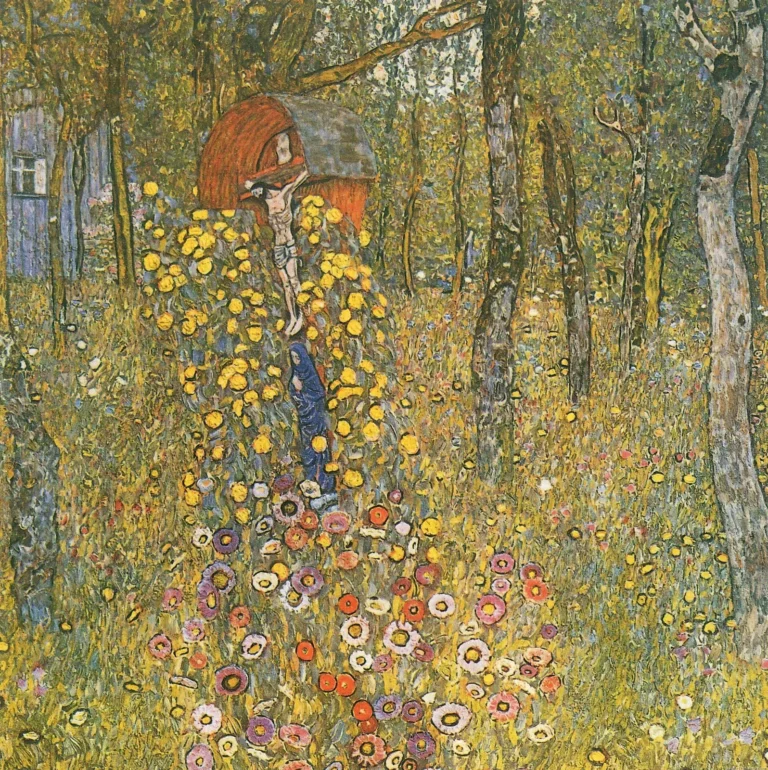
This oval composition shows a young woman in a flowing green robe seated at a keyboard instrument, her head turned upwards as if inspired. It personifies sacred music, and dates from Klimt’s early career as a decorative painter in the mid-1880s.
The painting
In 1883 Gustav Klimt, his brother Ernst and their friend Franz Matsch set up the Künstler-Compagnie (Artists’ Company), a partnership that decorated theatres and public buildings across the Habsburg empire. Oil sketches like this one were used to work out allegorical figures for ceilings, walls and publications. The soft, warm colours and the graceful, idealised figure show the influence of Hans Makart and of Italian Renaissance and Baroque painting.
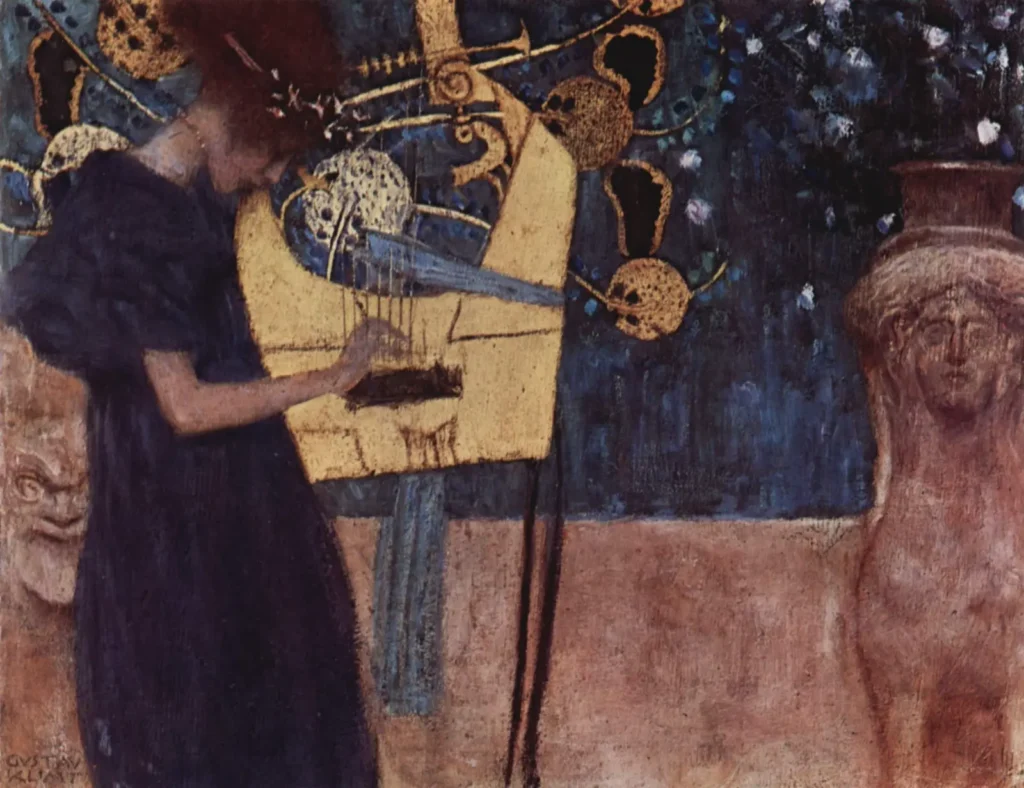
Music would remain a favourite subject. Compare it with Klimt’s later Symbolist treatments in Music I and Music II.
Where to see it
The work is in the Belvedere, Vienna. Read more about Klimt’s early work and the Künstler-Compagnie.
Sources and further reading
- Tobias G. Natter (ed.), Gustav Klimt: The Complete Paintings, Taschen
- Frank Whitford, Klimt, Thames & Hudson
- Klimt Foundation, Gustav Klimt Database
Image: Gustav Klimt, Allegory of Sacred Music, public domain, via Wikimedia Commons.
 Music I
 Allegory of Sculpture
 Fable
 Klimt’s early work