Judith II, often called Salome, was painted by Gustav Klimt in 1909, eight years after Judith I. It is usually seen as the last major painting of his Golden Phase.
CompositionThe painting
On a very tall, narrow canvas, Judith strides across the picture, her torso bare and her body wrapped in a dense, richly coloured patterned robe. Her hands are bent like claws, and at the bottom of the picture she grips the hair of Holofernes’s severed head. Her face is sharp and her expression intense, a long way from the languid sensuality of the first Judith.
The titleJudith or Salome?
Like the first version, the painting has often been taken for Salome, the dancer who demanded the head of John the Baptist, and it is still widely known by that name. Klimt himself painted the story of Judith, the widow who beheads the Assyrian general Holofernes to save her people, and here makes her a figure of danger rather than piety.
HistoryBought by Venice
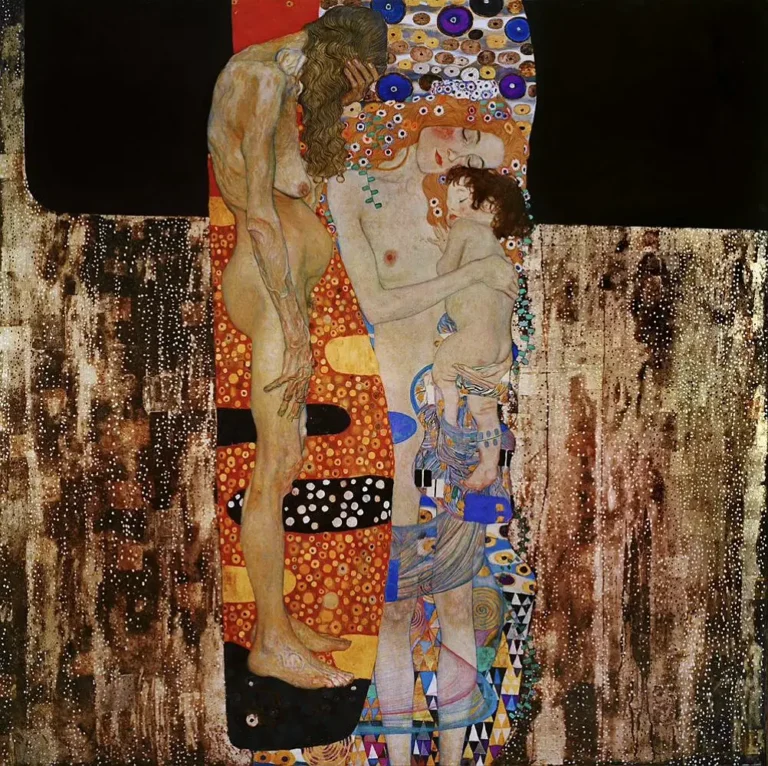
Klimt exhibited at the Venice Biennale in 1910, and Judith II was bought for the city of Venice. It has been in the Ca’ Pesaro, the city’s gallery of modern art on the Grand Canal, ever since. It is one of the few major Klimt paintings in Italy, along with The Three Ages of Woman in Rome. See our guide to where to see Klimt.
HistoryVenice and the 1910 Biennale
In 1910 Klimt was given a room of his own at the Venice Biennale, a sign of his international fame. Judith II was among the works he showed, and the city of Venice bought it for its modern art collection. It has hung ever since in the Galleria Internazionale d’Arte Moderna at Ca’ Pesaro, a Baroque palace on the Grand Canal.
That makes Judith II one of the few major Klimt paintings that left Austria in his lifetime and entered a public museum. For many visitors to Venice, it is a surprising discovery among the Italian paintings of the period.
ComparisonJudith I and Judith II compared
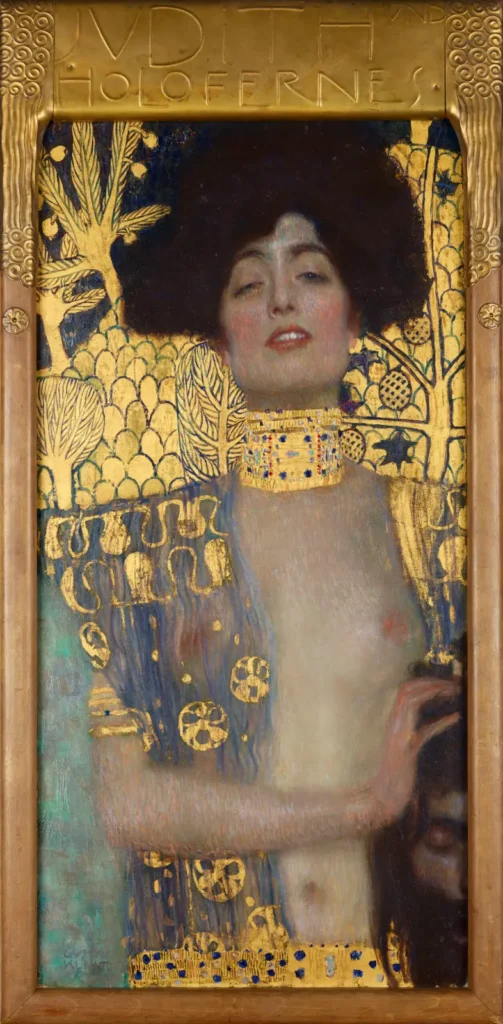
Eight years separate the two Judiths, and they are very different. Judith I (1901) is calm, sensual and golden; she looks out at the viewer through half-closed eyes, and Holofernes’ head is almost hidden at the edge of the picture.
Judith II (1909) is tense and aggressive. She is shown in profile, striding forwards, her bare breasts exposed, her fingers bent like claws as she clutches the head of Holofernes in a cloth at the bottom of the picture. The colours are darker, the pattern more angular, and gold plays a smaller role. Because of her cruelty she is sometimes called Salome, though Klimt did not use that title.
Both are tall, narrow pictures, and together they show how Klimt’s image of the femme fatale became harder and more expressive towards the end of the Golden Phase.
Quick facts10 facts about Judith II
- It was painted in 1909.
- It measures 178 × 46 cm.
- It shows the biblical Judith holding the head of Holofernes.
- It is sometimes called Salome.
- Her hands are bent like claws.
- Holofernes’ head appears at the bottom, wrapped in cloth.
- It was shown at the 1910 Venice Biennale.
- The city of Venice bought it after the Biennale.
- It hangs in Ca’ Pesaro, Venice’s gallery of modern art.
- It is darker and more aggressive than Judith I of 1901.
FAQFrequently asked questions
Where is Judith II by Klimt?
It is in the Galleria Internazionale d’Arte Moderna at Ca’ Pesaro in Venice, Italy.
Is Judith II the same as Salome?
No, but it is often called Salome because of its cruel, seductive mood. The subject is Judith with the head of Holofernes.
What is the difference between Judith I and Judith II?
Judith I (1901) is calm, golden and sensual; Judith II (1909) is darker, more angular and aggressive, with clawing hands.
How did Judith II end up in Venice?
Klimt showed it at the 1910 Venice Biennale and the city of Venice bought it for its modern art museum.
How big is Judith II?
178 × 46 cm, a very tall, narrow format.
Sources and further reading
- Ca’ Pesaro, International Gallery of Modern Art, Venice: collection entry for Giuditta II
- Tobias G. Natter (ed.), Gustav Klimt: The Complete Paintings (Taschen)
- Frank Whitford, Klimt (Thames & Hudson, World of Art)
Image: Gustav Klimt, Judith II (Salome), public domain, via Wikimedia Commons.
 Judith I
 The Golden Phase
 Where to see Klimt
 All Klimt paintings