Marie Henneberg
Painted for a new house on the Hohe Warte, designed by Josef Hoffmann, where the portrait hung in the hall.
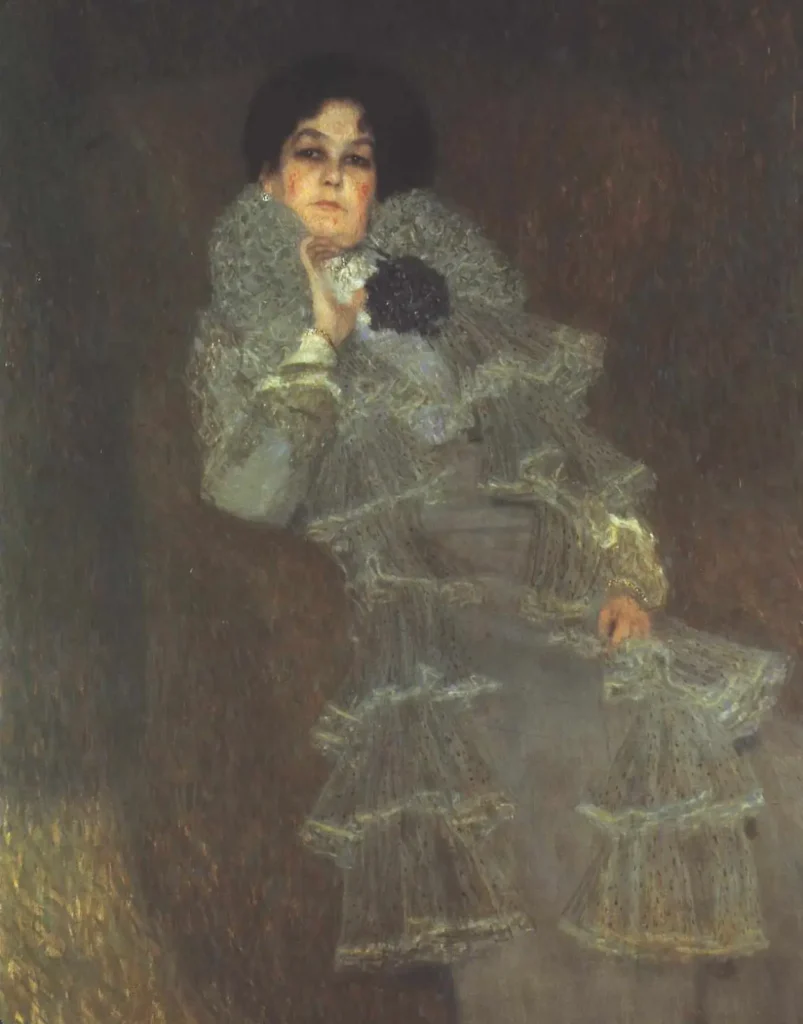
Marie Henneberg was the wife of Hugo Henneberg, a physicist and one of Vienna’s leading art photographers, who was also a member of the Secession. Klimt painted her in 1901–02 for the villa Josef Hoffmann was building for the couple.
| Married | Hugo Henneberg, photographer |
|---|---|
| Portrait | 1901–02, oil on canvas, 140 × 140 cm |
| Painted for | Villa Henneberg, Hohe Warte, Vienna (Josef Hoffmann) |
| Where to see it | Kunstmuseum Moritzburg, Halle (Saale) |
LifeWho she was
The Hennebergs belonged to a small artists’ colony on the Hohe Warte in Vienna’s 19th district, where Hoffmann built a group of houses for Secession members and their friends in 1900–02. Hugo Henneberg was a pioneer of the soft-focus “pictorialist” photograph, and his landscapes share much with Klimt’s early Attersee paintings.
The paintingThe portrait
Klimt seated her in a pale dress that fades into a shimmering, misty background, using the square format of his landscapes. The portrait was designed for the hall of the Hoffmann villa, an early example of the Secession ideal of the house, furniture and pictures conceived together as one work of art.
The painting is now in the Kunstmuseum Moritzburg in Halle, Germany. See our Portrait of Marie Henneberg page.
FAQFrequently asked questions
Who was Marie Henneberg?
Marie Henneberg was the wife of the Viennese photographer and Secession member Hugo Henneberg. Klimt painted her portrait in 1901–02.
Where is the Portrait of Marie Henneberg?
In the Kunstmuseum Moritzburg in Halle (Saale), Germany.
Why is it square?
Klimt used the square format for many works from around 1898, including his landscapes; it suited the decorative, flattened space he was developing.
 The Secession years
 Klimt’s patrons
 Klimt’s models and muses