Pallas Athene was painted by Gustav Klimt in 1898 and shown at the second exhibition of the Vienna Secession. It is one of the first paintings in which he used gold, and a manifesto for the new movement.
MeaningThe goddess of the Secession
Pallas Athene, the Greek goddess of wisdom, the arts and just war, was a natural patron for a group of artists fighting the conservative establishment. Klimt had already used her on the poster for the Secession’s first exhibition. In the painting she appears as a warrior: gold helmet, armour and spear, confronting the viewer with a cold, direct stare.
SymbolsThe painting
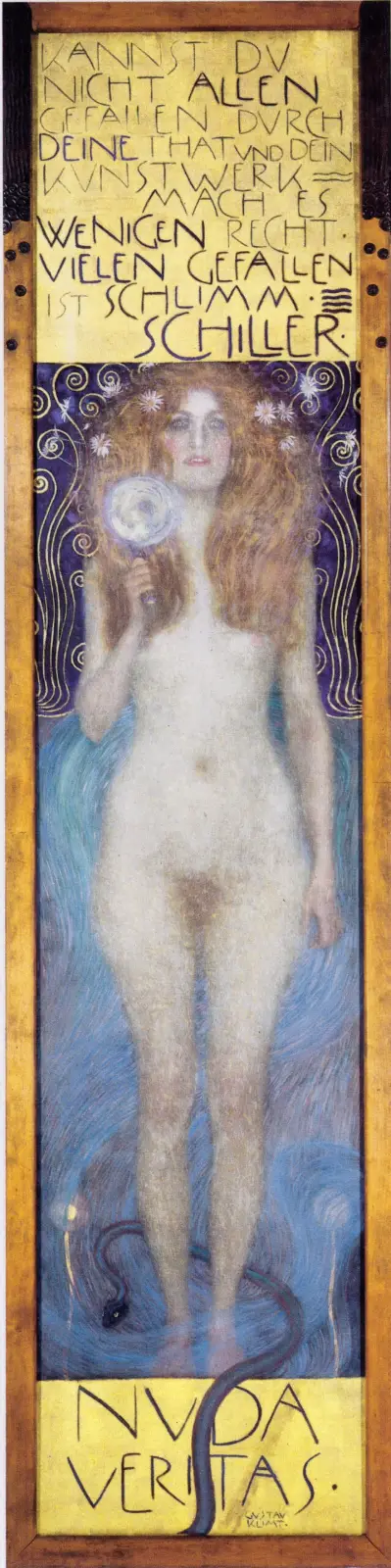
Athene’s breastplate bears the head of the Gorgon, sticking out its tongue in mockery, often read as Klimt’s gesture of defiance towards his critics. In her right hand she holds a small figure of a naked woman holding up a mirror, a version of Nuda Veritas (Naked Truth), the theme of the painting Klimt made the following year. The square canvas and the use of gold point forward to the Golden Phase.
VisitWhere to see it
Pallas Athene belongs to the Wien Museum on Karlsplatz in Vienna, which also owns Klimt’s Love and his portrait of Emilie Flöge. See our guide to where to see Klimt.
ContextThe goddess of the Secession
Pallas Athene, the Greek goddess of wisdom and the arts, was the chosen symbol of the Vienna Secession, the group of artists Klimt led when it broke away from Vienna’s official artists’ association in 1897. Her image appeared on the Secession’s first poster in 1898, designed by Klimt, where she watches Theseus slay the Minotaur.
In this painting, shown at the Secession’s second exhibition in 1898, she is no gentle muse but a warrior: helmeted, armoured, staring straight out at the viewer. In her right hand she holds a tiny figure of Nike, or of naked Truth, an early version of Nuda Veritas. Her breastplate carries the face of the Gorgon, sticking out its tongue, a cheeky challenge to the critics.
The square format and the beaten-metal frame, made by Klimt’s brother Georg, point the way to his Golden Phase. The painting is in the Wien Museum. See the Vienna Secession.
ExploreRelated works
If you are interested in Pallas Athene, these works by Klimt make good companions:
- Tragedy (1897): also in the Wien Museum, another allegory.
- Fable (1883): also in the Wien Museum, another allegory.
- Idyll (1884): also in the Wien Museum, another allegory.
- Love (1895): also in the Wien Museum, another allegory.
Browse every known work in our catalogue of Klimt’s paintings, or find out where every Klimt painting is today.
FAQFrequently asked questions
Where is Pallas Athene today?
Pallas Athene is in the Wien Museum, Vienna.
When did Gustav Klimt paint Pallas Athene?
Klimt painted Pallas Athene in 1898. It belongs to his Secession years around 1897–1902, when he broke with academic painting.
How big is Pallas Athene?
It measures 75 × 75 cm, or about 30 × 30 inches. The square format was a favourite of Klimt’s, used for almost all his landscapes and several portraits.
What materials did Klimt use for Pallas Athene?
It is oil on canvas.
Sources and further reading
- Wien Museum: collection entry for Pallas Athene
- Tobias G. Natter (ed.), Gustav Klimt: The Complete Paintings (Taschen)
- Frank Whitford, Klimt (Thames & Hudson, World of Art)
Image: Gustav Klimt, Pallas Athene, public domain, via Wikimedia Commons.
 The Vienna Secession
 Judith I
 The Golden Phase
 All Klimt paintings