Adam and Eve is one of Gustav Klimt’s last paintings, begun in 1916 and left unfinished at his death in February 1918.
CompositionThe painting
On a very tall, narrow canvas, Eve stands naked in the foreground, her pale body glowing, her head tilted and her long blonde hair falling over one shoulder. Behind her, darker and partly hidden, Adam leans with his eyes closed, as if asleep. At Eve’s feet is a carpet of flowers, often identified as anemones.
Eve firstMeaning
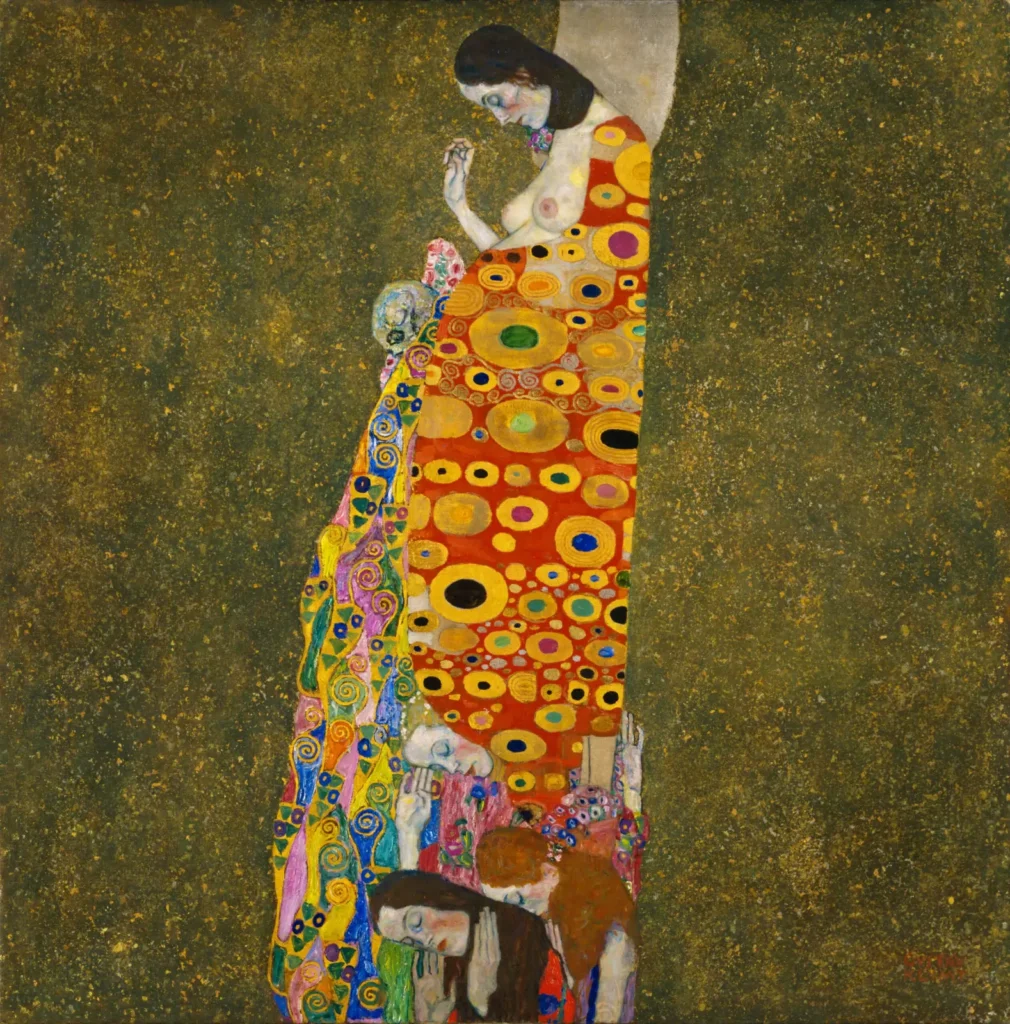
Klimt turns the traditional image of the first couple around: Eve, not Adam, is the centre of attention, confident and luminous, while Adam is a shadowy presence behind her. There is no apple and no serpent. The painting continues the theme of woman as the source of life that runs through Klimt’s work, from Hope to The Maiden.
VisitWhere to see it
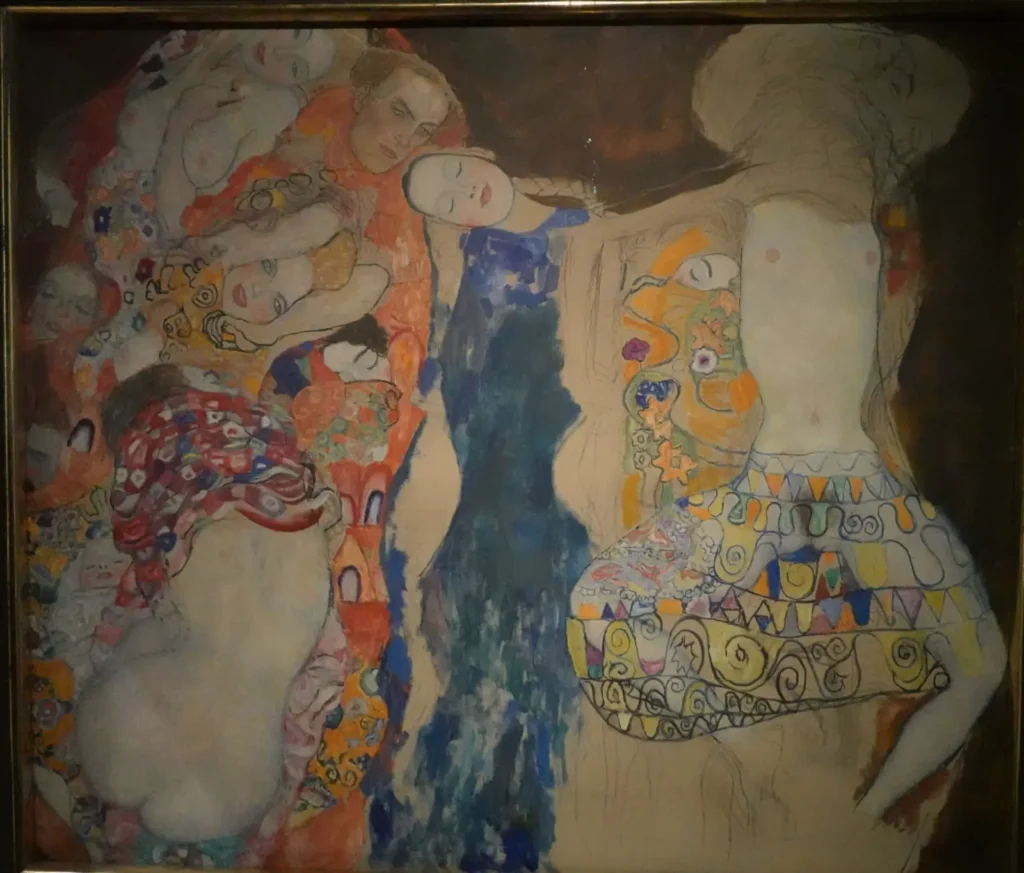
Adam and Eve is in the Belvedere in Vienna, alongside The Bride, another painting left unfinished in Klimt’s studio. See our guide to Klimt at the Belvedere.
DetailsLook closer
Adam and Eve is a tall, narrow canvas, 173 × 60 cm, dominated by the figure of Eve. She stands naked in the foreground, her pale body turned slightly, her blonde hair falling over her shoulder and her head tilted dreamily. Behind her, almost hidden, is Adam, darker and sleeping, his face pressed into his arm.
At Eve’s feet lie a leopard skin and a cluster of red and white anemones, flowers associated in classical myth with love and loss. There is no serpent, no apple and no Garden of Eden: Klimt reduces the biblical story to a man and a woman, and gives the woman all the light.
The painting was still unfinished when Klimt died in 1918, and parts of Adam and the background are only roughly laid in.
ThemeKlimt’s women and men
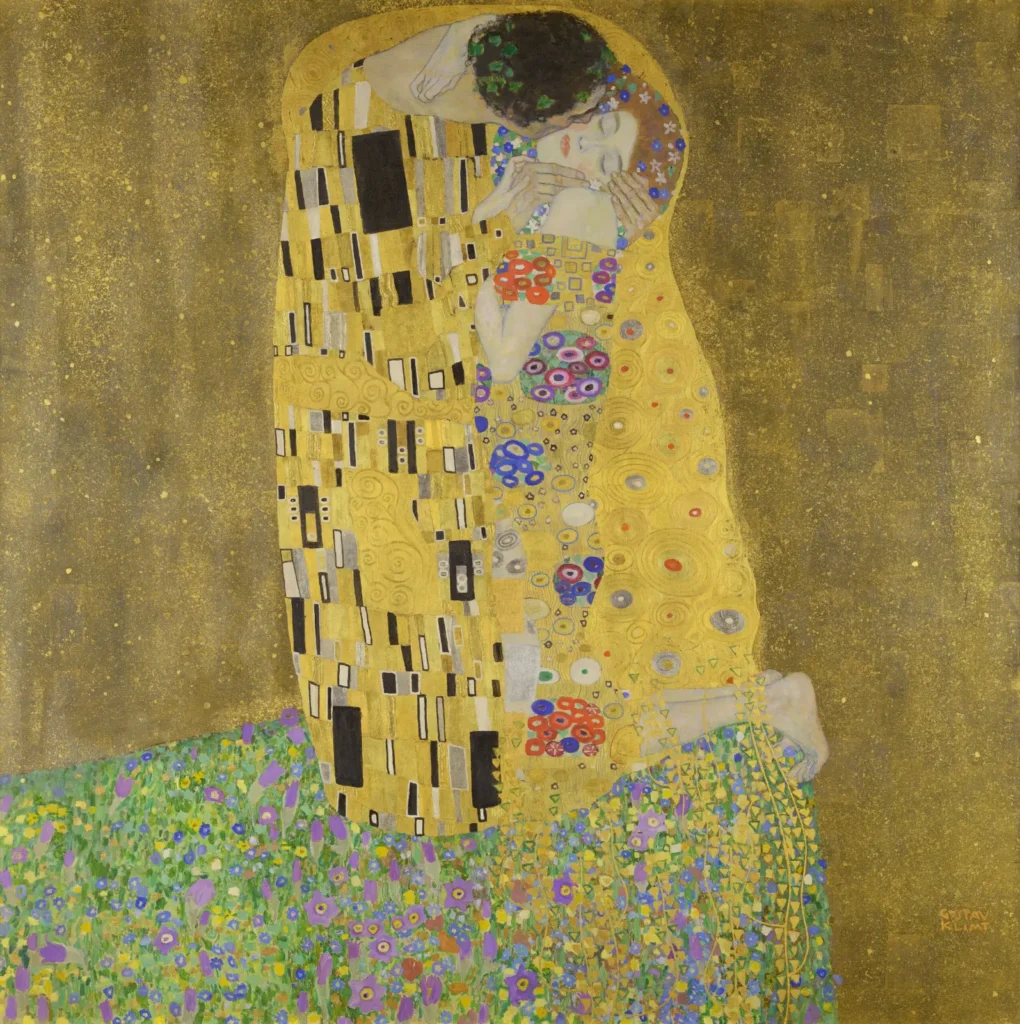
In almost all Klimt’s paintings of couples, the man is hidden, turned away or in shadow, while the woman is shown in full light. In The Kiss we see the man only from behind; in the Stoclet Frieze’s Fulfilment he is a dark, patterned back; and in Adam and Eve he is almost swallowed by the background.
This reflects Klimt’s lifelong focus on women, as lovers, mothers, goddesses and femmes fatales. Men appear in his early portraits and in the Beethoven Frieze, but after 1900 his art is overwhelmingly about women. Read more in Klimt’s models and muses.
Quick facts10 facts about Adam and Eve
- It was painted in 1916–18.
- It measures 173 × 60 cm.
- It was left unfinished at Klimt’s death.
- Eve stands in the foreground; Adam sleeps behind her.
- There is no serpent or apple in the picture.
- A leopard skin and red and white anemones lie at Eve’s feet.
- Its tall, narrow format recalls Judith II and Nuda Veritas.
- It is one of only a few biblical subjects in Klimt’s work.
- It is in the Belvedere in Vienna.
- It is one of the last paintings Klimt worked on.
FAQFrequently asked questions
Where is Adam and Eve by Klimt?
It is in the Belvedere in Vienna.
Is Adam and Eve finished?
No. Klimt was still working on it when he died in 1918, and parts of Adam and the background are unfinished.
What is at Eve’s feet in Klimt’s Adam and Eve?
A leopard skin and a group of red and white anemones.
Why is Adam hidden in the painting?
Klimt nearly always gave the woman the central, illuminated role in his paintings of couples, leaving the man in the background or in shadow.
When was Adam and Eve painted?
Between 1916 and 1918.
Sources and further reading
- Belvedere, Vienna: collection entry for Adam and Eve
- Tobias G. Natter (ed.), Gustav Klimt: The Complete Paintings (Taschen)
- Frank Whitford, Klimt (Thames & Hudson, World of Art)
Image: Gustav Klimt, Adam and Eve, public domain, via Wikimedia Commons.
 The Bride
 Hope II
 Klimt at the Belvedere
 All Klimt paintings